
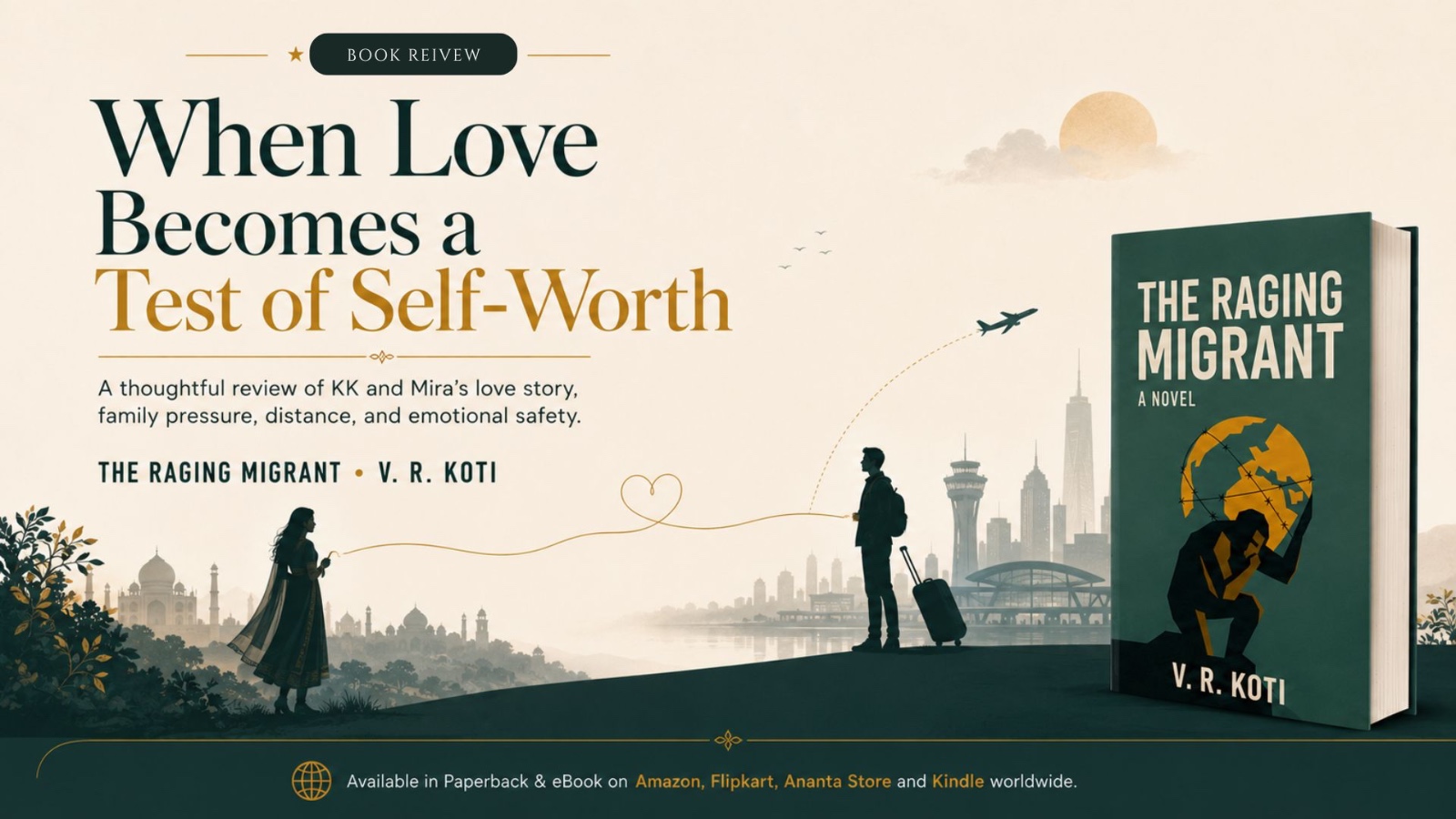
Before KK crosses a country border, he first has to cross the invisible borders inside his own home.
A powerful way to read The Raging Migrant is not only as a migration novel, but as a family novel. Long before Krishna Kant Sharma, or KK, reaches America, he is already living in a divided world. His family home is divided by thin walls, unspoken pain, financial debt, alcohol, duty, guilt, and love that has become tired from carrying too much. V. R. Koti understands something very important: for many people, migration does not begin at the airport. It begins at the dining table, in the overheard argument, in the unpaid loan, in the mother’s silence, in the father’s helplessness, and in the child’s private decision to become the one who will fix everything.
This review focuses on why the family side of the novel is so important. Many stories about Indians moving abroad begin with aspiration: admission, visa, flight, opportunity. The Raging Migrant begins with instability. KK’s father drinks. His mother carries the burden of keeping the household from collapsing. His grandmother has sharp observations and a strong presence even when she is physically limited. Aunt Lakshmi’s arrival brings the family’s hidden debt into the open. The loan of ₹12.5 lakh is not just an amount; it is a revelation. It tells KK that the house he thought he understood contains secrets, weakness, and economic fear.
The opening pages work because they are emotionally precise. Koti does not need to make the family melodramatic. Instead, he shows ordinary disorder with painful clarity. A father missing in the night. A mother searching. A grandmother needing care. A relative arriving with anger and entitlement. A son trying to remain polite while slowly realising the scale of the crisis. The scene is full of tension, but it is also full of recognisable truth. Many readers will understand this kind of family atmosphere: everyone knows something is wrong, but nobody says it clearly until the problem becomes impossible to hide.
KK’s position in the family is especially moving. He is freshly out of college, not yet financially secure, but already emotionally responsible. He wants to repay the debt. He wants to buy back his mother’s jewelry. He wants to create a future family built on respect because his own family has shown him what happens when respect slowly disappears. These desires make him sympathetic, but they also reveal how heavy his burden is. He is not simply ambitious. He is trying to rescue the idea of family itself.
This is why the title of the first chapter, Onward or Away?, becomes meaningful. KK’s movement is not a clean act of progress. He is torn between staying and leaving. If he stays, he may be swallowed by the same crisis. If he leaves, he may feel guilty for abandoning the people who need him. This is a common immigrant dilemma, especially in families where children are expected to become the emotional and financial solution. The novel does not simplify this dilemma. It allows the reader to sit with the discomfort.
The book is important because it shows how family can be both shelter and wound. KK loves his mother, father, and grandmother. He is not trying to erase them from his life. Yet the family has also trained him in fear, avoidance, and over-responsibility. The father’s drinking creates emotional insecurity. The mother’s endurance becomes admirable but also painful. The grandmother’s sharpness gives strength, but the household still feels trapped. The loan creates pressure. The fights at night create sleeplessness. The result is a young man who becomes skilled at “tuning things out,” but tuning out is not the same as healing.
This idea is one of the novel’s strongest contributions. The book suggests that silence is not neutral. Silence has a cost. When a family avoids truth, the truth does not disappear. It enters the body. It becomes anxiety, guilt, anger, fear of confrontation, and confusion about love. KK’s later life, including his relationships and choices in America, cannot be understood without this early training in silence. He has learned to survive by staying alert, by pleasing others, by controlling himself, and by trying to become useful. These habits help him in some situations, but they also place him under emotional strain.
The Raging Migrant shows that migration often carries family silence across borders. The immigrant may leave the house, but the house does not leave him. When KK goes to Delhi and later to America, he takes with him the memory of arguments, debt, shame, love, and responsibility. The mother’s pressure cooker, the father’s reminders, the family’s financial condition, and the secret wishes of home all travel with him. This is why the book feels honest. It knows that an international flight cannot cut emotional ties.
The relationship between KK and his father is complex and important. His father is not presented as a simple villain. He drinks, fails, hides, and causes pain, but he also has moments of concern. At the train station, he locks KK’s luggage with a chain, asks him to eat on time, and tells him to call. These small gestures show that love can exist even where responsibility has failed. This complexity gives the novel maturity. It does not allow the reader to hate the father easily, nor does it excuse him. It shows him as a flawed human being whose weakness has consequences.
KK’s mother is one of the quiet emotional pillars of the story. She struggles to keep the family together, but the novel does not turn her into a sentimental symbol. She has fatigue, worry, and the burden of holding everything. Her jewelry becomes a recurring emotional image. When KK wants to buy back her jewelry, he is not thinking only about gold. He is thinking about restoring dignity. He wants to undo the humiliation his mother has endured. That desire explains much of his drive. His ambition is love wearing the clothes of responsibility.
The grandmother adds another layer. She is sharp, direct, and often darkly humorous. Her presence gives the family scenes a mix of realism and wit. She understands survival. She warns KK to adapt like a chameleon. Her advice is practical, but also emotionally loaded. Adaptation becomes one of the novel’s central ideas. Immigrants adapt to new cities and cultures, but children of troubled families also adapt to unpredictable homes. KK’s later success depends on adaptation, yet the book also asks whether adaptation becomes dangerous when it means suppressing pain.
Aunt Lakshmi is an important character because she externalises pressure. She enters the story with silk, jewelry, anger, and demand. She represents the social and financial world pressing into the private home. Her demand for repayment turns hidden debt into public humiliation. Through her, Koti shows how money can reshape relationships. A loan inside a family is never only a loan. It can become power, resentment, control, and moral judgment. This scene also helps the reader understand why KK feels that he must leave and earn more. The economic crisis is not abstract. It is sitting on the sofa.
The family narrative also makes the migration narrative emotionally believable. Without the family background, America might look like an exciting opportunity. With the family background, it becomes both opportunity and escape. KK’s dream is not free of desperation. He wants education and career growth, but he also wants distance from chaos. The novel’s honesty lies in showing that these motives can coexist. A person can love his family and still need to leave. A person can leave for a better future and still feel like he has failed those he left behind.
This is why the book is meaningful for readers today. In many societies, especially in South Asian families, children are often expected to succeed not only for themselves but for everyone connected to them. Their achievements carry the dreams, sacrifices, and debts of an entire family. The Raging Migrant respects this reality while also showing its emotional danger. When one person becomes the family’s hope, that person may lose the right to be confused, tired, young, or imperfect. KK’s journey is partly a fight to recover that right.
The novel also helps readers understand how dysfunction can shape love. KK later struggles with conditional love, secrecy, emotional safety, and the need to prove himself. These are not random relationship problems. They are connected to what he has seen at home. His father and mother have negotiated badly. Love has survived, but not always with dignity. KK wants a different model, but he has to learn how to build it. The book is therefore valuable because it connects family history with adult relationships. It shows that we do not enter love as blank pages. We bring the grammar of our childhoods.
The style of writing in the family sections is one of restraint. Koti does not shout at the reader. He uses tension, small gestures, conversations, and internal questions. This restraint makes the pain sharper. A loud dramatic scene may be forgotten, but the image of KK lying awake while his parents argue through walls that feel too thin stays with the reader. The novel understands that emotional violence is often repetitive and ordinary. It happens at night, in half-heard sentences, in the next morning’s silence, and in the child pretending everything is normal.
The family theme also broadens the meaning of the word “migrant.” KK is a migrant not only when he goes abroad. He is a migrant inside his own family. He moves between son, protector, debtor, dreamer, student, lover, and future provider. He is always crossing from one role to another. This makes the novel richer. It suggests that identity is not a fixed place; it is a series of movements under pressure.
As a book review, the key point is this: The Raging Migrant matters because it refuses to separate personal success from family pain. It asks readers to look at the emotional foundation beneath ambition. It tells us that before we celebrate the person who leaves, we should understand what made leaving necessary. It also reminds us that healing requires more than distance. KK can go to Delhi, America, or anywhere else, but he still has to face the inner architecture built by his family.
This is a strong and relevant novel for readers who enjoy stories about family, migration, identity, and emotional truth. It will especially connect with readers who know what it means to love imperfect parents, carry financial pressure, or become responsible too early. V. R. Koti has written a story that is intimate yet widely relatable. The Raging Migrant shows that home is not always a safe place, but it is always a powerful place. It shapes us, follows us, and demands to be understood. That is why this book is important.
The novel is available in paperback and e-book formats, with availability shared on Amazon, Flipkart, Ananta Store, and for international readers in 150 plus countries. Readers looking for a thoughtful literary novel about family pressure and the emotional truth behind migration should pick it up not because it promises escape, but because it understands why escape is sometimes mistaken for freedom.