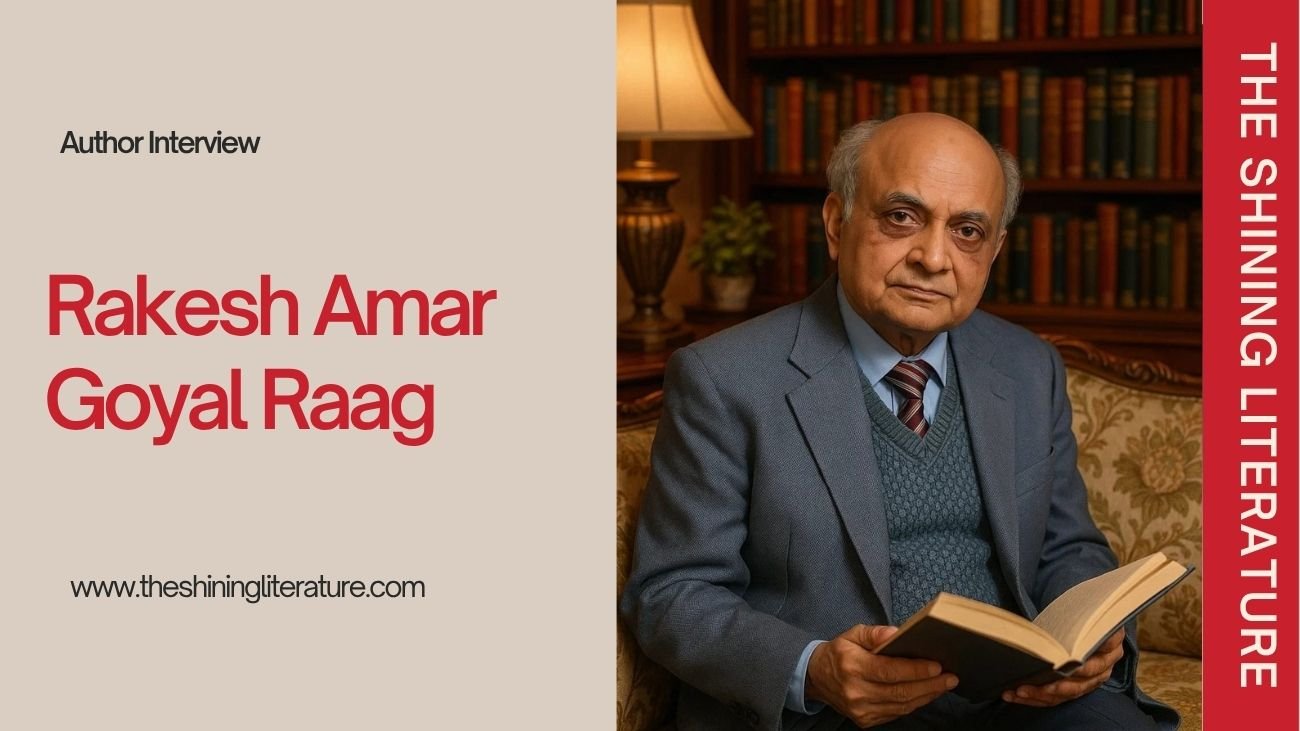
Congratulations on the release of The Indus Maiden and the Arab Soldier: Love and War on the Indus. How does it feel to share this book with readers worldwide?
I, Rakesh Amar Goyal Raag, thank you for congratulating me on the release of my novel, The Indus Maiden and the Arab Soldier.
It is both gratifying and humbling to share this book with readers worldwide. A story that began in my imagination and is rooted in the landscapes and history of eighth-century Sindh, in the tumultuous aftermath of its Arab conquest, has now travelled far beyond its original setting to meet readers from various cultures and backgrounds.
At its core, the book is wrapped in history and the high stakes of war, yet it is driven by universal human experiences of love, faith, sacrifice, courage, and destiny. These emotions transcend both time and culture. The most rewarding thrill for me is to witness readers from diverse countries and backgrounds resonate with the emotional journeys of the book’s characters.
What inspired you to write The Indus Maiden and the Arab Soldier, and why did you choose eighth-century Sindh as the setting for the story?
The inspiration for this novel, The Indus Maiden and the Arab Soldier, came from a very personal connection with Sindh. My mother spent five years of her later childhood in Sukkur, where my maternal grandfather worked as a civil engineer during British India. Though I had never lived there myself, Sindh had always existed in my imagination as a place connected with family memories, the Indus, and a landscape rich in history.
While exploring that history, I became fascinated by the events surrounding the Arab conquest of Sindh in the eighth century. I chose the eighth-century Sindh setting because it provided the perfect, high-tension atmosphere for a suspenseful thriller. I wanted to look beyond the battlefield and delve into what might happen when two young individuals from two different civilizations find themselves drawn to each other. Through them, I wanted to explore not only what divides civilizations, but also what connects human beings across the boundaries of time, culture, and belief.
The novel combines history, romance, suspense, and war. How did you approach balancing these different elements while developing the story?
While developing the story of the novel The Indus Maiden and the Arab Soldier, I approached the elements of history, romance, suspense, and war in a way so as to weave them like warp and woof to make one single, whole, and inseparable fabric. Each of these elements gives the novel its strength, texture, and completeness. If you pull one out, the entire fabric falls apart.
If you pull out history or war, the very foundation of the story of this novel collapses.
If you pull out romance, the emotional heart of this novel ceases to palpitate.
With uncertainty, danger, secrets, and moments when the characters themselves cannot be sure what fate has in store for them, suspense keeps the story of this novel moving. If you pull it out, the story’s movement is immobilized.
Forbidden love lies at the heart of the novel. What did you want to explore through the relationship between the Indus maiden and the Arab soldier?
The novel, The Indus Maiden and the Arab Soldier, unfolds a heart-touching tale of forbidden love as a prism that unveils the deeper truths of civilizational encounters, demonstrating that history is not solely inscribed in battles and treaties but also in human connections that challenge inherited boundaries.
Through lovers’ relationship, I wanted to explore the convergence of two worlds at the Indus transforming from a mere tale of conquest into a narrative of recognition, where each civilization sees itself reflected in the eyes of the other.
The love between the protagonists allows the reader to experience history not merely through battles and political events, but through the hopes, fears, sacrifices, and choices of ordinary human beings.
The Arab conquest of Sindh forms an important historical backdrop. What kind of research did you undertake to recreate the period, its people, and its cultural atmosphere?
To recreate the period, its people, and its cultural atmosphere for the novel The Indus Maiden and the Arab Soldier, I conducted extensive research, concentrating on constructing a vibrant and authentic historical world as the basis for a setting where love, war, faith, sacrifice, and destiny could naturally unfold against the turbulent backdrop of eighth-century Sindh.
I conducted research on the historical accounts of the Arab conquest of Sindh, focusing on key locations such as Debal, Aror, and Brahmanabad, as well as the political and military context of the era. In addition, I explored Hindu traditions, the arrival and spread of Islam, Sufi philosophy, local customs, social relationships, and the interactions between different communities, thereby examining the religious and cultural landscape of the period.
I studied the Indus River, its changing landscape, and the rhythms of life along its banks. I also studied the forts, temples, Sufi hospices, settlements, boats, and routes. This exploration enabled me to envision the surroundings of the characters, as well as what they might have seen, heard, and felt.
I would like to specifically mention the following books that I consulted for this novel:
Chachnama (English translation by Mirza Kalichbeg Fredunbeg); Rigved (Swami Dayanand Saraswati’s Hindi translation alongside the original Sanskrit text, upto 7th Mandala, Sukta 61, Mantra 2, and Arya Muni’s Hindi translation of 7th Mandala from Sukta 61, Mantra 3 onwards alongside the original Sanskrit text); Mandukya Upanishad (Swami Sarvanand’s English translation alongside the original Sanskrit text);
Baladuri’s Futuh al-Buldan (Volume 2, English translation by F.C. Murgotten); Quran (English translation by J. M. Rodwell and Urdu translation by Maulana Ashraf Ali Thanvi); Charaka Samhita (Hindi translation by Atirdevaji Gupta); Sushruta Samhita (Hindi translation by Ambikadatt Shastri);
and Ashtanga Hridaya (Hindi translation by Shiv Sharma).
In this context, I would also like to highlight that, in addition to my research, I drew significantly upon my mother’s memories of her late childhood in Sukkur, Sindh, for Sufi saints’ hospices, kafi, faqirs, dervishes, Sindhi fisherfolk, ladas (wedding folksongs), the palla fish, and the landscape of Sindh in the novel, The Indus Maiden and the Arab Soldier.
The novel also touches upon Sufi saints, Hindu hermits, dream interpreters, faith, and spirituality. What role do these elements play in the story?
Sufi saints, Hindu hermits, dream interpreters, faith, and spirituality form an important undercurrent of the story in the novel, The Indus Maiden and the Arab Soldier. They represent the mysterious realm that exists beyond the visible world of armies, politics, conquest, and conflict. They serve as the vital connective tissue between the characters and their turbulent world.
Despite their different paths, the Sufi saints and Hindu hermits share a deeper, universal understanding of humanity. They act as moral compasses, offering guidance and emotional support.
Dream interpreters act as the bridge between the conscious world and the unseen forces of fate.
Faith and spirituality give the characters the resilience to survive, elevating the romantic plot from a simple love story into a grand testament to sacrifice.
Love, sacrifice, redemption, and cultural encounters are important themes in the book. Which of these themes is personally most meaningful to you as an author, and why?
While all of these themes are deeply woven into the fabric of the novel The Indus Maiden and the Arab Soldier, the one that resonates most profoundly with me is sacrifice.
To me, sacrifice is the ultimate crucible for character. Love acquires its deepest meaning when it demands sacrifice. When a character gives up his safety, his homeland, or his desires for a higher purpose or for the person he loves, his true essence is revealed.
You have written several books and have also published stories and articles in English and Hindi. How has your writing evolved over the years?
My writing journey commenced in 1966 when, as a school student, I won first prize in a children’s story writing competition held by Nandan, a renowned children’s magazine published by the Hindustan Times group.
My early stories were driven largely by imagination and the excitement of creating characters and situations. As I continued writing, my interests broadened. My professional life exposed me to people from different regions and walks of life, while my reading deepened my interest in literature, history, religion, sociology, and human behaviour. With that, my writing, including my articles, became more research-driven and layered.
My early writing was primarily about discovering the joy of storytelling. The novel, The Indus Maiden and the Arab Soldier, along with all my writing today, is about using storytelling to explore people, cultures, history, and the enduring complexities of the human heart.
Your interests include literature, history, religion, and sociology. How have these interests influenced your storytelling and the creation of this novel?
My interests in literature, history, religion, and sociology come together quite naturally in my storytelling, including this novel, The Indus Maiden and the Arab Soldier.
Literature taught me to look beyond events and enter the emotional world of characters by exploring their hopes, anxieties, desires, and moral dilemmas.
History provided the canvas. The turbulent aftermath of the Arab conquest of Sindh is a fascinating, pivotal moment in history. It is a period of massive geopolitical shift. My love for history drove me to meticulously research this period.
My interest in religion helped me explore the spiritual dimension of the story. Hindu traditions, Islamic beliefs, Sufi thought, mysticism, dreams, and ideas of destiny all become part of characters’ inner journeys.
Sociology facilitated the mapping of societal friction, class dynamics, and cultural synthesis as two different civilizations interact.
What do you hope readers will take away from The Indus Maiden and the Arab Soldier after finishing the final page?
I hope, after finishing the final page, the readers take away from the novel The Indus Maiden and the Arab Soldier the conviction that love transcends the barriers erected between human beings by history, culture, and conquest.
Are you active on social media? How can readers follow you, connect with you, or stay updated about your upcoming books and writing?
I am active on social media. Readers can follow me on Instagram (https://www.instagram.com/raag24.26/) and Facebook (https://www.facebook.com/profile.php?id=61573299065773&rdid=VXOYcu51fkz3ZIcX). They are welcome to contact me via email. My email ID is raag2760@gmail.com
Where can readers buy The Indus Maiden and the Arab Soldier: Love and War on the Indus? Is it available internationally in both print and digital formats?
The book, The Indus Maiden and the Arab Soldier, is available internationally in both print and digital formats. (Here please incorporate the details of where readers can buy this book.)
Thank you, Rakesh Amar Goyal Raag, for taking the time to answer our questions and share the story behind The Indus Maiden and the Arab Soldier: Love and War on the Indus. We wish you continued success with the book and your future literary journey.