Congratulations on the release of Vinoda’s Vengeance! What inspired you to write a historical novel set in the Indo-Greek kingdom of Menander?
The inspiration for Vinoda’s Vengeance dates to my school days, when fragments of ancient history first caught my attention, particularly the philosophical dialogue of the Milinda Panha and a classroom story set in the Indo-Greek world that left me unsatisfied. Years later, those early impressions resurfaced and aligned with my fascination with classical drama, especially the works of Sophocles, ultimately shaping the foundation of this novel.
I was driven by a desire to explore the intersection of cultures at a time when Greek and Indian civilizations didn’t merely clash but coexisted and influenced one another in profound ways. What began as a simplistic story evolved into a far more layered narrative that examines identity, conflict, and the complexities of human choices.
Vinoda is a remarkably strong and complex protagonist. How did you develop her character, and was she inspired by any historical figures?
I did not portray any known historical person or model. History is full of heroic deeds by men, such as warriors, kings, or saints, and rarely by female characters. If any, the motivation for a heroic deed is different. I have explored this aspect in one of the last chapters, aptly titled “Not for Fame or Fortune.” This fictional person came to me and appealed to me while reading the drama by Sophocles.
Your novel blends Indian and Greek cultures beautifully. What kind of research went into recreating this fascinating period of history?
I had to research Gandhara culture and the convergence of Hellenism, Buddhism, and Hinduism. In addition, I had to work out the classical and Hellenistic periods, especially the culture, traditions, and values from the Greek point of view.
As someone with a background in science, archaeology, and multiple languages, how have your life experiences influenced your storytelling?
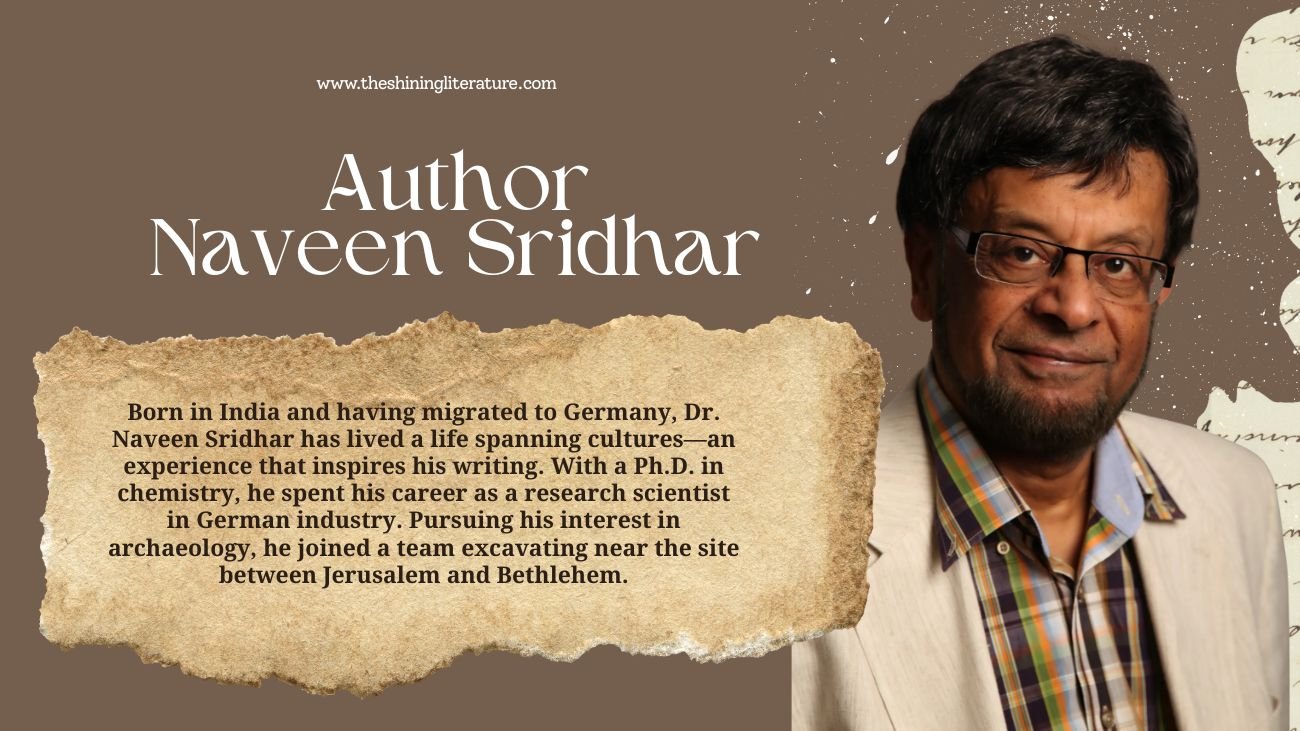
A great question. A lifelong commitment to inquiry, both scientific and human, may have shaped my writing. As a research scientist, I developed a rigorous approach to exploration and attention to detail, which I later carried into storytelling. My interest in archaeology reached a climax when I took part in an excavation in Israel at a site between Jerusalem and Bethlehem.
As for writing, I began with a guide to entertainment. The motivation to write fiction came only after writing the biography of German women during and after World War II (Candlelight in a Storm), a non-fiction work that stuck to facts: events, reports, and personal contacts. My scientific background kept me from writing fiction. But the response (major award, etc.) opened the door, allowing my fantasy to take part in my debut historical fiction set in Mesopotamia about the first-ever literary person (Starlight in the Dawn). In the story about the first-ever peace treaty between two ancient powers (A Hittite and A Shaman), I had to navigate the principles and sensitivities of two civilizations. The scientific caution to stick to facts and truth stayed on, but only by setting boundaries and limitations like plausibility. The research experience helped me dig into the deep past. Languages helped me not be hindered by ancient languages and scripts.
What was the biggest challenge you faced while writing Vinoda’s Vengeance?
The biggest challenge for me was to conform to the known history of the age and region. The next challenge was this: historical fiction, as opposed to history itself, must deal with imagined characters and even events. The reader must be able to set aside reality and believe in the story, at least for the moment. I quote Samuel Taylor Coleridge (1817) on the phrase “a willing suspension of disbelief”.
History often focuses on rulers and wars, yet your novel highlights ordinary people. Why is it important for you to tell these overlooked stories?
At the heart of my work is a question that has stayed with me since my school days: what about the lives of ordinary people? While history often centers on kings and conquerors, I have always been drawn to the untold stories of those who lived in their shadows. This perspective, influenced in part by my late mother, a recognized author in India, runs through all my writing, blending meticulous research with a deep focus on human experience.
I met ordinary people in Germany after World War II. This led me to write the biography of the ordinary women during and after World War II.
What do you hope readers will take away after finishing Vinoda’s Vengeance?
Morals, social norms, government regulations, and beliefs are guidelines, not absolute laws of nature. In moments of crisis, anyone can face impossible choices, left to fend for themselves with no clear answers.
That’s why I urge readers to look beyond judgment and consider the unseen pressures behind every decision. In a world shaped by uncertainty, the real question is not only what we would do but also whether we can truly judge others’ actions.
On reading the book,
- Judge her not. On the contrary, consider how you would have acted, not from today’s perspective nor as a judge in court.
- Now, you be the judge and decide her fate.
Are you currently working on another book or historical fiction project that readers can look forward to?
Yes. I am now working on a story set in Ancient Rome. The exciting part is its relevance to modern times, both in a period of relative peace and prosperity and in a time affected by the erratic whims of world leaders, trade barriers, and the consequences for ordinary people.
Next in the queue is an untold story set in the past and staged in India, which had a serious effect on a mighty power of the era.
Are you active on social media? Where can readers connect with you and stay updated on your latest work?
I do not have time to be active on social media. Readers can write to me at naveen@sridhar.de, which I check daily.
Where can readers purchase Vinoda’s Vengeance and your other books?
My books were all published by Amazon: only Candlelight in a Storm was published by AhtourHouse.
All my books are available on Amazon. They may also be available from other sources in India.
What advice would you give to aspiring writers who want to write historical fiction?
- Use historical data as milestones for your story, or as dots to connect in a story.
- History will come to life in your story with the help of real historical figures and the characters you create.
- The story can then be carried by human aspects like rivalry, ambition, love, and suspense. Writing will be like driving along a road leading to a target (ending) yet constrained by historical verity.
- Keep the story grounded in plausibility rather than in pure fantasy.
- Check out books on writing interesting novels in general.
Thank you for taking the time to answer our questions. Is there anything else you would like to share with our readers?
We must value reading as a form of educational entertainment. All epic stories from the past offer us illustrious examples.
Turning to the distant past, oral storytelling was the only way to reach the illiterate world and to educate, upholding the principles embodied in the deeds of gods and heroes. This is indeed age-old and nothing new, but it has been out of focus as education and entertainment have become separate fields.
Later, with widespread literacy, reading largely replaced listening. Now that both venues are available, complemented by TV, the importance of education through entertainment ought to return to the fore, alongside stories and fiction for their own sake and for impact.
I believe culture progresses primarily through exposure to other cultures. Despite fears of a ‘clash of cultures’, in the modern world, with ever more contacts and intermingling due to digitalization, the internet, immigration, and tourism, a ‘globalization of culture’ is steadily advancing. This is the time to welcome and hail the traditional open-mindedness of ancient times, before the advent of intolerance.