
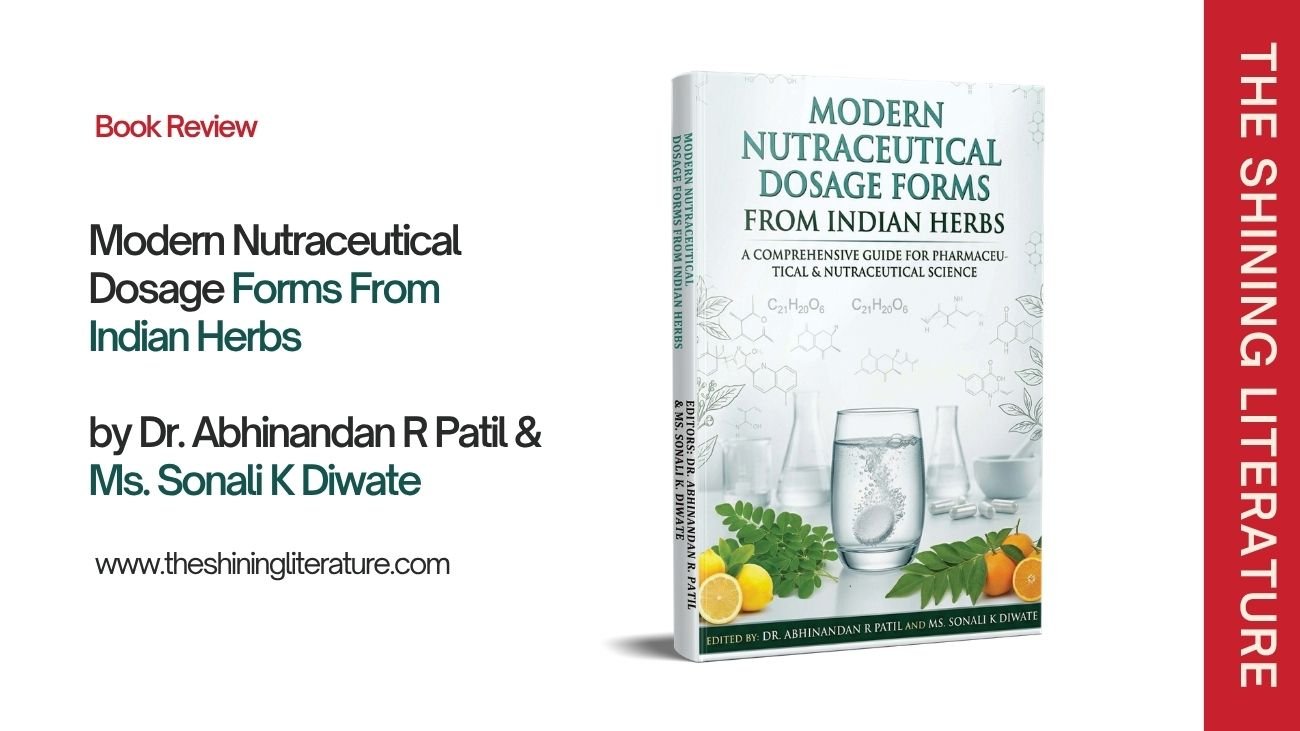
Modern Nutraceutical Dosage Forms From Indian Herbs by Dr. Abhinandan R Patil & Ms. Sonali K Diwate
Modern Nutraceutical Dosage Forms From Indian Herbs by Dr. Abhinandan R Patil and Ms. Sonali K Diwate is a comprehensive reference work exploring the science, development, formulation, analysis, and practical application of modern herbal nutraceutical dosage forms.
Designed for pharmaceutical scientists, nutraceutical formulators, regulatory affairs professionals, researchers, academicians, and advanced students, the book connects traditional Indian botanical resources with contemporary pharmaceutical formulation science.
A Scientific Approach to Modern Herbal Nutraceuticals
The nutraceutical industry continues to expand as researchers and formulators investigate botanicals for their nutritional, functional, and commercial potential. Developing an effective herbal nutraceutical product, however, requires much more than simply selecting a medicinal plant.
Formulation development involves understanding botanical materials, selecting suitable dosage forms, establishing appropriate analytical procedures, performing calculations, evaluating quality, and considering regulatory and commercial requirements.
Modern Nutraceutical Dosage Forms From Indian Herbs approaches these areas through an integrated scientific framework. Drawing on scientific literature, regulatory documentation, and established pharmaceutical formulation principles, the book is intended to function as both an academic resource and a practical working reference.
Connecting Herbal Knowledge With Pharmaceutical Formulation Science
One of the central objectives of the book is to demonstrate how Indian herbs can be approached within modern formulation science.
The text moves beyond general discussions of herbal ingredients by addressing technical aspects involved in transforming botanical materials into structured nutraceutical dosage forms.
Readers are introduced to formulation concepts, analytical approaches, calculation procedures, development frameworks, and decision criteria that can be considered during nutraceutical product development.
Focus on Moringa oleifera and Murraya koenigii
A significant feature of the book is its focus on Moringa oleifera and Murraya koenigii.
These botanicals provide practical examples through which broader formulation principles can be explored. Their relevance to the Indian nutraceutical landscape also makes them valuable subjects for researchers and professionals interested in plant-based product development.
Moringa oleifera in Nutraceutical Research
Moringa oleifera has attracted considerable interest in food, botanical, and nutraceutical research. Within the framework of this book, it serves as an important botanical example for examining how plant materials can be incorporated into modern nutraceutical development processes.
Rather than treating the botanical only from a traditional perspective, the book places it within a pharmaceutical formulation framework that considers practical development and analytical requirements.
Murraya koenigii and Modern Formulation Development
Murraya koenigii is another important botanical examined in the book. Commonly associated with Indian culinary and traditional uses, the plant also provides an interesting subject for contemporary nutraceutical research.
Its inclusion allows readers to consider how a familiar Indian botanical can be evaluated through systematic formulation and quality-focused approaches.
Practical Effervescent Granule Case Study
An important technical component of Modern Nutraceutical Dosage Forms From Indian Herbs is the detailed effervescent granule case study introduced in Chapter 2 and further developed through extended case studies.
The case study provides a concrete illustration of the principles discussed throughout the book.
From Scientific Principles to Practical Formulation
Case studies can help bridge the gap between theoretical pharmaceutical concepts and their practical implementation.
Through the effervescent granule example, readers can examine formulation considerations in a structured context. Specific formulations, analytical methods, calculations, and development decisions provide practical illustrations of how a nutraceutical formulation may be approached.
The case study is designed to support understanding of the development process rather than limiting the book’s relevance to a single product or botanical combination.
Broader Applications Across Indian Medicinal Botanicals
Although Moringa oleifera and Murraya koenigii receive particular attention, the scientific principles presented in the book have wider applications.
India possesses an extensive range of medicinal, nutritional, and traditionally used botanicals. Researchers working with different plant materials can adapt the frameworks and decision criteria discussed in the book according to the characteristics of their botanical material, intended application, dosage form, and commercial requirements.
Adaptable Frameworks for Researchers and Formulators
The book encourages readers to consider the presented methods as adaptable scientific frameworks.
Different botanicals have different phytochemical profiles, processing requirements, stability characteristics, and formulation challenges. Consequently, successful product development requires careful evaluation rather than a single universal formulation strategy.
The frameworks presented in the book can help readers establish a more systematic approach when investigating new botanical nutraceutical products.
Who Should Read Modern Nutraceutical Dosage Forms From Indian Herbs?
The book is particularly relevant to readers working or studying in pharmaceutical sciences, nutraceutical technology, herbal formulation, pharmaceutical quality assurance, botanical research, and regulatory affairs.
It can serve as a useful reference for pharmaceutical scientists, nutraceutical formulators, pharmacy researchers, regulatory affairs professionals, formulation scientists, academicians, postgraduate students, doctoral researchers, and advanced pharmacy students.
A Reference for Academic and Professional Use
For students and researchers, the book provides an opportunity to understand how pharmaceutical formulation principles can be applied to herbal nutraceutical development.
For professionals, its combination of conceptual frameworks and technical details provides a reference point for considering formulation strategies, analytical approaches, calculations, and development decisions within practical contexts.
About Dr. Abhinandan R Patil
Dr. Abhinandan Ravsaheb Patil, M. Pharm., Ph.D., Post Doc (CSIR), M.A. (Psychology), PGDM, ND (A.M.), is currently working as a Professor at D. Y. Patil College of Pharmacy, Kolhapur.
He obtained his Ph.D. in Pharmaceutical Sciences from D. Y. Patil University, Kolhapur, India, and completed his Bachelor’s and Master’s degrees in Pharmaceutical Science from Shivaji University.
His academic and research career includes extensive work in pharmaceutical sciences, research publications, patents, conferences, and scientific innovation. According to his author profile, he has more than 71 publications in peer-reviewed journals, along with 39 Indian and 9 international patents.
He has participated in numerous national and international conferences and has received recognition for his scientific and research activities, including Young Scientist awards.
About Ms. Sonali K Diwate
Ms. Sonali K. Diwate is an Associate Professor in the Department of Pharmaceutical Quality Assurance at D. Y. Patil College of Pharmacy, Kolhapur.
She brings a combination of academic and pharmaceutical industry experience to her work. Her professional background includes more than seven years of academic experience and eleven years of pharmaceutical industry expertise.
Research and Academic Interests
Her areas of interest include herbal formulations, cosmeceuticals, pharmaceutical quality assurance, formulation development, research, and pharmacy education.
She has guided more than 15 undergraduate students in academic projects and has contributed to national and international publications in her areas of specialization.
A Practical Resource for the Evolving Nutraceutical Field
Modern Nutraceutical Dosage Forms From Indian Herbs brings together botanical research and contemporary pharmaceutical formulation principles within the Indian nutraceutical context.
Its combination of scientific frameworks, formulation considerations, analytical methods, calculations, regulatory context, and detailed case studies makes it relevant to readers seeking a more structured understanding of herbal nutraceutical product development.
By examining Moringa oleifera and Murraya koenigii while presenting principles that can be adapted to other botanicals, the book provides a foundation for researchers, students, and professionals exploring the evolving relationship between India’s botanical resources and modern nutraceutical science.