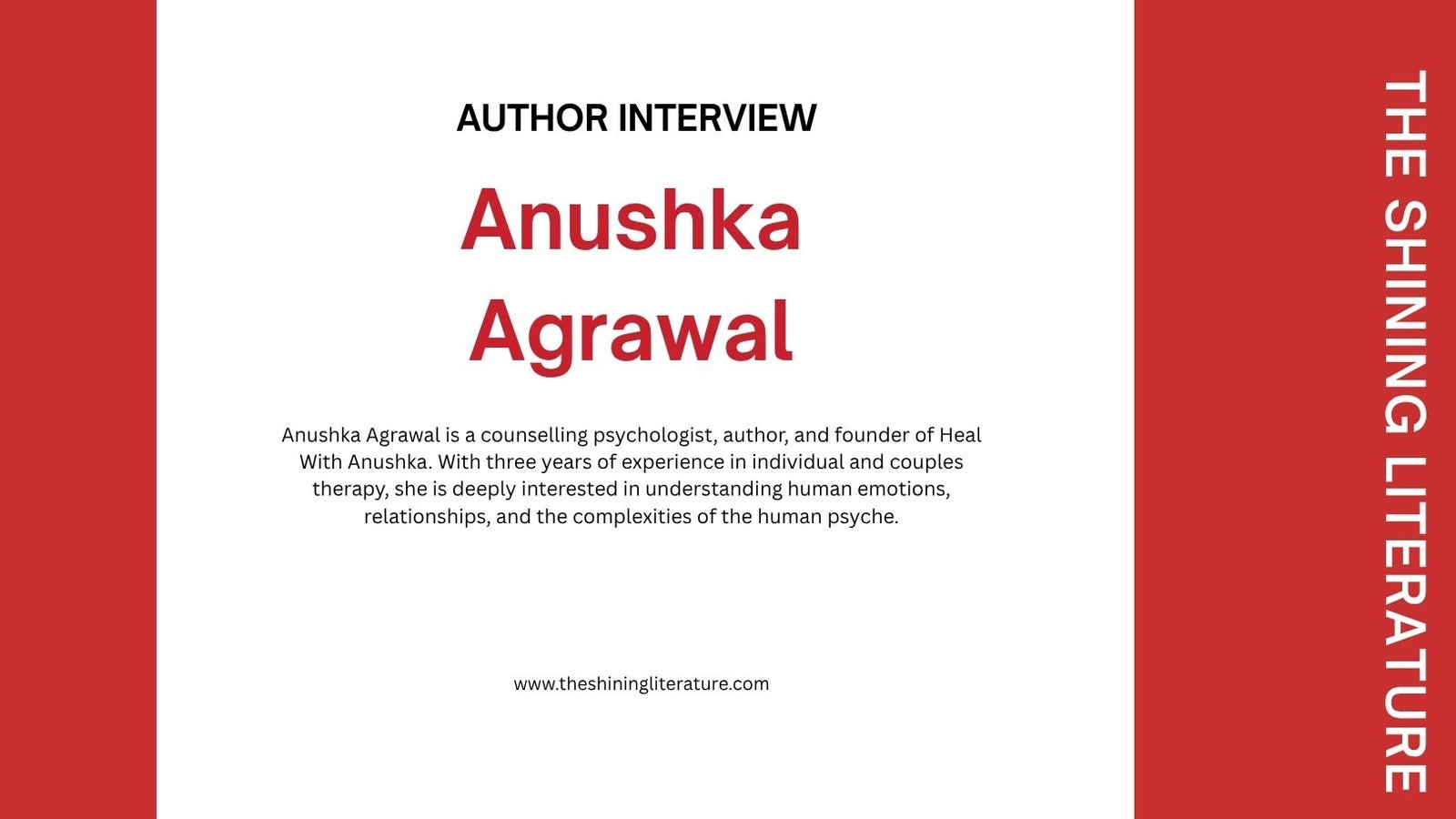
Anushka Agrawal is a counselling psychologist, author, and founder of Heal With Anushka. With three years of experience in individual and couples therapy, she is deeply interested in understanding human emotions, relationships, and the complexities of the human psyche.
Having authored five books, Anushka brings together her passion for psychology, literature, and philosophy in her writing. Deeply influenced by the works of Carl Jung, whose exploration of the unconscious, archetypes, and individuation resonates with her, she is fascinated by the hidden dimensions of human existence and the journey towards self-discovery.
Her writing reflects a contemplative approach to life, exploring vulnerability, inner conflicts, emotional healing, and the transformative power of self-awareness. Through both her professional work and literary pursuits, she hopes to encourage readers to look inward, embrace their complexities, and discover meaning in their experiences.
Discover more at www.healwithanushka.in.
1. Congratulations on the release of your book,
The Emotional Alchemist! How does it feel to share this deeply personal and reflective work with readers?
Thank you. It feels special to share something that comes from such a reflective space within me. I have always been fascinated by the depth of human emotions and the paradoxes of being human. Writing allows me to explore these experiences in ways that ordinary conversations sometimes cannot. I hope readers find something of themselves in my words, perhaps an emotion they could never articulate or a thought they have carried silently for years. For me, the beauty of writing lies in the possibility that something deeply personal can become universally relatable.
2. What inspired you to write
The Emotional Alchemist, and what significance does the title hold for you?
I have always been intrigued by the idea that life is an experience of all emotions, not merely the ones we consider pleasant. We often spend so much time wishing to escape pain that we forget how much of our understanding comes from engaging with our experiences. The title represents the possibility of transforming our relationship with our emotions. Just as an alchemist transforms one substance into another, I believe we can turn our experiences into awareness, understanding, and wisdom. It is not about romanticising pain, but about discovering what can emerge when we begin to understand ourselves more deeply.
3. Your book explores emotional wounds, vulnerability, and self-discovery. What message do you hope readers take away from these themes?
I hope readers realise that being human means making room for contradictions. We can be strong and vulnerable, hopeful and grieving, confident and uncertain, sometimes all at once. We do not have to reject parts of ourselves simply because they are difficult to understand. I want readers to approach their inner worlds with curiosity rather than judgment. Our emotions are not weaknesses to overcome; they are experiences to understand. Perhaps the journey towards self-discovery begins when we stop trying to become someone who feels nothing and start understanding the person who feels everything.
4. As a counselling psychologist, how has your professional experience influenced your writing and understanding of human emotions?
My experience of working with individuals and couples over the past three years has deepened my appreciation for the complexity of human emotions and relationships. It has reinforced my understanding that beneath our behaviours often lie needs, fears, experiences, and stories that deserve to be understood. Psychology has given me a framework for exploring these complexities, while writing allows me to express them more intuitively and philosophically. Although therapy and literature serve different purposes, both can create opportunities for reflection. My professional experience has taught me the importance of approaching human experiences with compassion, while my writing allows me to explore their nuances beyond the boundaries of formal psychological language.
5. The concept of transforming pain into understanding is central to your book. What does emotional alchemy mean to you personally?
For me, emotional alchemy is the art of allowing our experiences to transform us without allowing them to define the entirety of who we are. I have often wished that life could be experienced without so much pain, but I have come to appreciate the possibility of turning difficult experiences into something meaningful. It is not about pretending that pain is beautiful or that every wound needs to have a purpose. It is about reclaiming our relationship with what we have experienced. Sometimes pain becomes empathy, sometimes it becomes wisdom, and sometimes it simply teaches us what we can no longer abandon within ourselves. That transformation, however imperfect, is what emotional alchemy means to me.
6. Your writing reflects an interest in psychology and philosophy, particularly the works of Carl Jung. How have his ideas influenced your perspective on human emotions and self-discovery?
Carl Jung has always fascinated me because of his exploration of the unconscious, the shadow, and the journey towards individuation. His ideas invite us to look beyond the identities we construct for the world and examine the parts of ourselves we may have ignored, suppressed, or struggled to accept. I find the concept of the shadow particularly meaningful because self-awareness requires us to acknowledge not only what we admire in ourselves but also what makes us uncomfortable. My interest in philosophy complements this fascination by encouraging me to question the meaning of existence and the nature of being human. Together, these perspectives have shaped my belief that self-discovery is not about becoming perfect; it is about becoming more conscious of who we are.
7. Many people struggle to express their deepest emotions. Do you believe poetry and literature can help individuals better understand and communicate their feelings?
Absolutely. Sometimes we experience emotions long before we possess the language to articulate them. Poetry and literature can offer words, metaphors, and images for experiences that otherwise remain difficult to communicate. A reader may encounter a passage and suddenly recognise something they have felt for years but could never explain. That recognition can be profoundly meaningful. Literature also allows us to encounter perspectives beyond our own, helping us develop empathy for experiences we may never personally understand. I believe writing can become a bridge between what we feel internally and what we are finally able to acknowledge, express, and share with others.
8. Having authored five books, how has your journey as a writer evolved over the years? What makes
The Emotional Alchemist different from your previous works?
Having written five other books, my journey as a writer has allowed me to explore different dimensions of human experience and expression. Over time, I have become increasingly interested in the subtleties of emotions, the contradictions within our inner worlds, and the philosophical questions that emerge when we begin examining our existence. The Emotional Alchemist is particularly meaningful to me because it brings together my interests in psychology, philosophy, and poetic reflection. Rather than attempting to provide definitive answers, these writings create space for questions, interpretations, and personal discoveries. I want readers to experience the work in their own way and find meanings that resonate with their individual journeys.
9. Your book explores the coexistence of darkness and light, strength and vulnerability. Is there a particular poem or passage that holds special meaning for you?
One passage that holds particular significance for me explores the idea of a light that exists within us but remains undiscovered until something gently brings it to the surface. I write about a soul that has spent so long protecting itself that it has forgotten the possibility of feeling safe enough to soften. What moves me about this idea is the possibility that transformation does not always require us to become something entirely new. Sometimes, it involves recognising what has existed within us all along. I am drawn to the paradox that even when we feel fragmented, there may be parts of ourselves waiting to be understood and integrated. That possibility of rediscovery lies close to the heart of the book.
10. What advice would you give to readers who are struggling with emotional pain, self-doubt, or the process of discovering themselves?
I would encourage them to be patient with themselves. We often expect ourselves to heal quickly, understand everything immediately, and move forward without looking back. But self-discovery is rarely a straight line. You do not need to turn every painful experience into a lesson, nor do you have to find meaning in everything that happens to you. Sometimes, acknowledging that something hurt is enough for that moment. Allow yourself to feel without judging yourself for feeling. Seek support when you need it, and remember that growth does not always look like progress from the outside. Sometimes, it is simply learning to listen to yourself, honour your needs, and make choices that bring you closer to the life you wish to live.
11. Are you active on social media? How can readers connect with you, follow your work, and learn more about your future literary projects?
Yes, readers can connect with me on Instagram at @psychologistanushka, where I share reflections on psychology, emotional well-being, relationships, and self-discovery. Through my platform, Heal With Anushka, I also work towards making conversations about emotional health more accessible and meaningful. Readers can visit www.healwithanushka.in to learn more about my work as a counselling psychologist and the services I offer. I hope to continue creating content and writing that encourages people to understand themselves more deeply and approach their emotional experiences with greater compassion.
12. Where can readers purchase
The Emotional Alchemist? Are there any upcoming books or projects you would like to share with your audience?
I invite readers to visit amazon.in to explore my work and find information about The Emotional Alchemist. As for future projects, I hope to continue exploring the intersection of psychology, philosophy, and literature through my writing. There are many aspects of the human experience that continue to fascinate me, and I look forward to giving some of those questions a voice through future literary projects. For now, I hope The Emotional Alchemist finds its way to readers who enjoy reflecting on life, exploring the depths of their emotions, and discovering meaning in the complexity of being human.
Thank you for having me. It has been a pleasure sharing the thoughts and experiences behind The Emotional Alchemist. I hope the book encourages readers to embrace the depth of their emotions and discover their own interpretations of what it means to live, feel, and become.
Book review: The Emotional Alchemist