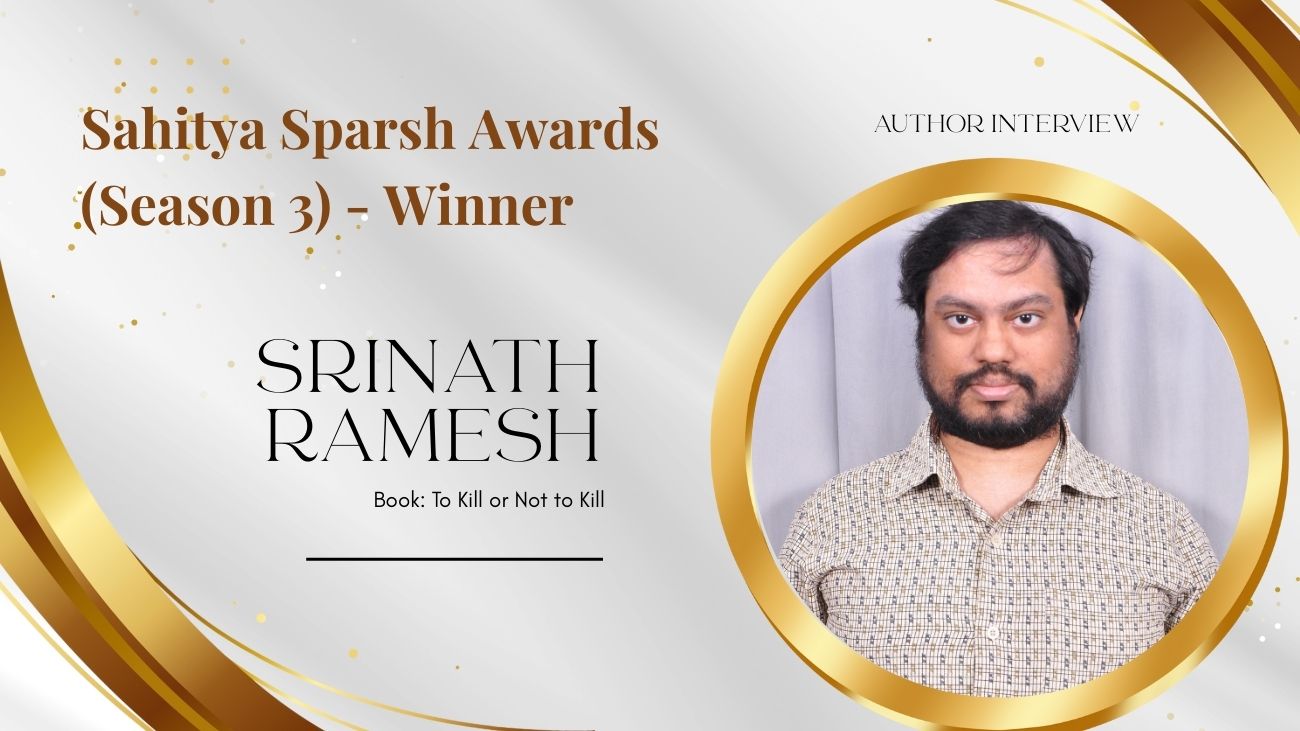
1. Congratulations on the release of your book To Kill or Not To Kill, and on winning the Sahitya Sparsh Awards – Season 3. How does this recognition feel, especially for your debut novel?
Thank you. The recognition feels deeply fulfilling. My interest in storytelling began nearly fifteen years ago during my undergraduate days. However, due to financial responsibilities and professional commitments, I was unable to pursue writing seriously at that time. Coming from a humble background, entering the workforce immediately after college was essential to support and stabilize my family.
After spending more than a decade in the IT industry, I reached a stage where I felt the need for deeper creative and personal fulfillment. This realization led me to step away from my corporate role and dedicate myself to storytelling. I initially explored screenwriting, driven by my passion for cinema. One of my screenplays went on to receive international festival nominations and even won an award.
Eventually, I felt compelled to translate my stories into novels, as the form allows greater psychological depth and emotional exploration. Winning a prestigious award for my debut novel is incredibly validating — not only as recognition for the book itself, but as affirmation of a long, patient journey toward storytelling.
2. What inspired you to develop the character of Leo Martin and explore such deep psychological themes in this story?
My passion for cinema led me to study filmmakers across eras and cultures, and noir as a genre has always fascinated me. With Leo Martin, I wanted to explore a character conditioned into an immoral profession — someone trained to suppress emotion, empathy, and moral choice.
The core idea was to introduce a disruption into that conditioning: the re-emergence of suppressed emotions, humanity, and moral responsibility. I wanted to examine how genuine love could affect such a person, how it might awaken his conscience, and how he would confront both his own conditioning and the powerful organization that shaped him. Ultimately, Leo’s journey is about reclaiming agency in a life designed to deny it.
3. Your background in filmmaking and influences from legendary directors like Tarkovsky, Bergman, Lynch, Kubrick, and Kurosawa are fascinating. How have these cinematic influences shaped your writing style?
Each filmmaker I admire has influenced a different aspect of my storytelling. Tarkovsky’s ability to extract poetry from the mundane — even from simple images like objects submerged underwater — inspires me to refine my visual language and slow moments down, allowing meaning to surface organically. His philosophical engagement has also been a major influence.
Bergman’s exploration of human relationships, inner conflict, and existential questions has profoundly shaped my character work. One of my screenplays, for instance, is a Bergman-style romantic drama that examines success, public scrutiny, and the emotional dynamics of a celebrity couple.
Lynch taught me how to approach surrealism and dream logic, while Kubrick instilled in me the importance of artistic integrity — never diluting ideas, even when working on a large or commercially accessible scale. Kurosawa’s compassion, understanding of social systems, and moral complexity continue to inspire my thematic choices. Alongside these masters, many other filmmakers have shaped my creative sensibility.
4. Before becoming a full-time storyteller, you worked in the IT industry for nearly a decade. How did that journey lead you toward writing screenplays and eventually a novel?
Before entering the IT industry, I had story ideas and theoretical knowledge, but my professional life provided real-world experiences that later enriched my writing. My work involved root-cause analysis, structured problem-solving, and eventually team leadership — all of which helped me understand human behavior, responsibility, and decision-making under pressure.
There was also a strong emphasis on customer satisfaction and relationship management, which sharpened my understanding of professional ethics and interpersonal dynamics. These experiences indirectly shaped how I construct characters, systems, and conflicts in my stories.
5. Your screenplay From a Drop to an Ocean received multiple international recognitions. How different was the experience of writing a novel compared to writing a screenplay?
The difference is substantial. A screenplay follows a rigid structure — scene headings, action lines, dialogue, and transitions — and limits the writer to what can be visually represented. A novel, by contrast, allows for continuous prose, multiple points of view, internal monologues, and deeper psychological exploration.
Although the screenplay for To Kill or Not To Kill was completed in 2024, transforming it into a novel required time and reimagining. The novel format enabled me to expand the emotional and philosophical layers in ways a screenplay simply cannot.
6. The book has achieved remarkable rankings on Amazon India, entering the top 1 percent for paperbacks and the top 0.15 percent on Kindle. Did you expect such a strong response from readers?
I honestly did not. I initially viewed this as an independent work that might gain modest traction and gradually find its audience over time. Instead, readers embraced the book through purchases, reviews, and organic word-of-mouth promotion in overwhelming numbers.
It feels as though readers have accepted me as one of their own, which is especially meaningful because I was a passionate reader long before I ever became an author.
7. What was the most challenging part of writing To Kill or Not To Kill? Did any moment change the direction of the story?
The most challenging aspect was writing Alice’s character. She exists in a moral gray zone, and understanding her choices was initially difficult. As the story evolved, her motivations became clearer, and I realized her perspective required deeper exploration. I hadn’t originally planned to dedicate a chapter to her, but it eventually felt essential for both narrative balance and reader understanding.
Additionally, Chapter IV — The Lost Memories — was initially conceived very differently. It focused on a complex political system within the hotel industry, where control depended on internal power struggles. Over time, I realized that this external complexity was overshadowing the novel’s philosophical core. I reworked the chapter to refocus on character psychology and thematic depth.
8. The novel deals with themes such as identity, memory, morality, and the illusion of control. What do you hope readers take away from Leo Martin’s journey?
The novel explores themes such as free will versus control, moral responsibility under coercion, childhood trauma and its lingering effects, identity fragmentation, the ethics of ends versus means, the domination of power systems, the transformative power of emotion, and ultimately, how love conquers violence.
At its core, To Kill or Not To Kill argues that:
- Love shapes morality before logic does
- Identity formed without love becomes mechanical
- Freedom without safety is an illusion
Philosophically, the story resonates with Aristotle’s view of emotion as moral perception, Spinoza’s understanding of love as an expansion of being, existentialist ideas of freedom grounded in emotion, modern psychology’s view of emotion as an ethical regulator, and Nietzsche’s exploration of conditioning and power.
The central belief of the novel is simple yet profound: emotion is the foundation of morality, identity, and freedom. Restore love, and violence collapses under its own weight. The novel also serves as a homage to noir and psychological thrillers, where complex human beings collide over money, power, desire, and love.
9. Are there any future writing projects or screenplays readers can look forward to?
I have completed five screenplays so far: To Kill or Not To Kill, Does God Moonlight?, Of Grace and Gravity, From a Drop to an Ocean, and The Pyramid of Life.
My next project involves adapting Of Grace and Gravity into a novel. It is a tender love story about a high-achieving celebrity couple navigating professional ambition, personal intimacy, and societal expectations while living under constant public scrutiny.
10. You are currently pursuing an MBA. How do you balance academic life with creative writing and filmmaking?
I manage my time by prioritizing tasks and focusing on what requires immediate attention. This approach allows me to balance academics with writing and filmmaking.
Creatively, I don’t follow a rigid daily word-count routine. I work in bursts. Some days ideas flow effortlessly; on others, very little emerges. I’ve learned that writing cannot be forced — it has to happen organically.
11. Are you active on social media? How can readers connect with you?
Yes, I am active on social media and would love to connect with readers.
- Facebook: https://www.facebook.com/srinath.r.htanirs
- LinkedIn: https://www.linkedin.com/in/srinath-r-82265826/
- Instagram: https://www.instagram.com/srinathworldview/
Readers are welcome to follow or message me directly. I genuinely read every message and deeply value those conversations.
12. Where can readers buy your books, and is there anything you would like to say to your readers before we wrap up?
The book is available on Amazon India, Canada, the US, and the UK. In India and Canada, it is available in both paperback and Kindle editions.
Amazon links:
- India: https://www.amazon.in/dp/B0FBS6FR53
- Canada: https://www.amazon.ca/dp/B0FBS6FR53
- UK (eBook): https://www.amazon.co.uk/dp/B0FHFZML4M
- US (eBook): https://www.amazon.com/dp/B0FHFZML4M
Readers can also order by phone or WhatsApp at +91 8148066645, or through the publisher’s website:
https://www.swasambookart.com/books/9788198681492
Message to Readers:
Above all, I want to say thank you.
To everyone who picked up To Kill or Not To Kill, read it with patience, reflected on it, shared it, reviewed it, or recommended it — you gave this book a life far beyond what I ever imagined. Every message and conversation reminded me why stories matter.
This book was written during a transitional phase of my life, driven more by quiet persistence than certainty. The way readers embraced it — especially as a debut novel — reaffirmed my belief that honest storytelling always finds its audience, even if the journey takes time.
I am deeply grateful for the trust you placed in my work. I promise to continue writing stories that respect your intelligence, engage your emotions, and remain true to the ideas that matter to me. This award belongs as much to the readers as it does to the author.
Thank you for walking this journey with me.