Interview – Kumari Vandana Singh
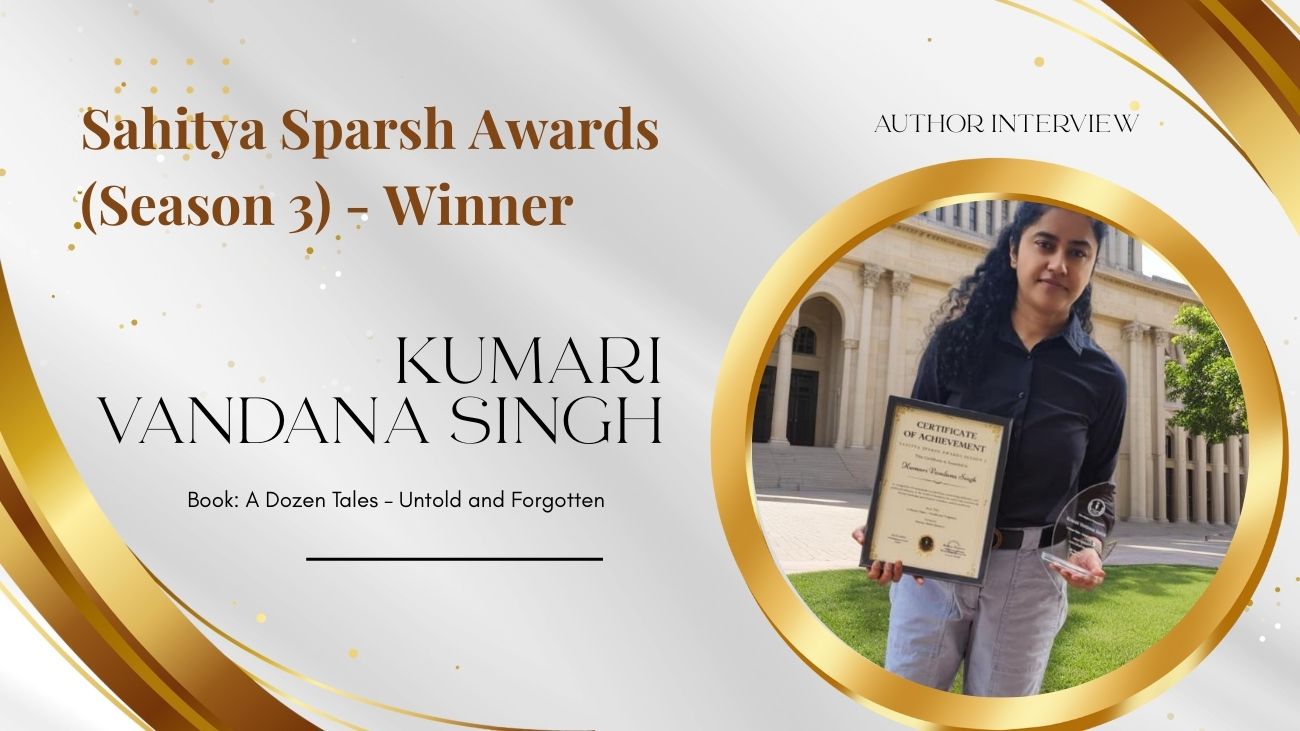
1. Congratulations on the release of A Dozen Tales Untold and Forgotten and on winning the Sahitya Sparsh Awards Season 3. How does this milestone feel for you as a writer and artist?
Thank you so much. It feels deeply affirming, like the quiet moments of writing and painting over the years have finally found a wider audience that listens. Winning the award and releasing the new edition together feels like a turning point, both a celebration of past work and an encouragement to keep exploring. I’m grateful, humbled, and energized all at once.
2. Your creative journey began in childhood. Can you share how your early love for poetry, storytelling, and painting shaped the writer you are today?
From a young age, I was drawn to the rhythm of words and the colors on paper. Poetry taught me to listen closely to language, the way a single word can carry emotion. Storytelling gave me a sense of wonder about people’s lives, how every person holds a world within. Painting trained my eye to observe details, light, and shadows. Together, these early passions taught me to pay attention, to look beneath the surface, and to express what might otherwise go unnoticed. That foundation still shows up in how I write today, with curiosity, compassion, and an urge to bring hidden moments into view.
3. You are a business educator by profession and a writer and artist by passion. How do you balance these different roles, and do they influence each other?
Balancing them is a daily dance. Teaching and academic work give structure, deadlines, and an active community, while writing and art feed my inner life and imagination. Rather than seeing them as separate, I let them inform each other. Teaching sharpens my clarity and discipline, which helps when shaping a story. Creative work reminds me why I enjoy learning and connecting in the first place. Sometimes I switch from a classroom to a quiet corner with paper and pen; other times a vivid classroom discussion inspires a scene or character. It isn’t always easy, but the diversity keeps me energized and engaged.
4. Your Hindi poetry collections Kavya Shrinkhala and Kavya Silsila explore themes like corruption, politics, gender inequality, and childhood. How did these themes evolve when you shifted to English short stories in A Dozen Tales Untold and Forgotten?
Those core concerns, justice, human dignity, memory, remain central, but the form and lens changed. Poetry often captures a feeling, a sharp image, or a single moment; short stories allow me to follow a person’s journey more fully. In A Dozen Tales, I still explore social and personal struggles, but through the lives of characters we can watch over time. The shift to English opened up different rhythms, different readers, and sometimes a different cultural frame, yet the heart of the themes remains, highlighting the overlooked, questioning systems, and honoring lived experiences.
5. Many of your stories focus on unheard voices and everyday struggles. What inspires you to write about these silent, often forgotten narratives?
I believe every life has a story worth listening to, especially those that rarely appear in headlines or textbooks. I’m inspired by people I meet, by small daily scenes, and by the quiet resilience in ordinary moments. There’s something powerful in bringing attention to those soft spoken stories, showing that even the simplest life can hold courage, heartbreak, humor, and wisdom. Writing them is also a personal reminder to stay humble and attentive, to respect the dignity of people whose stories are rarely told.
6. Your artistic work spans figurative, landscape, still life, and abstract painting. Do your visual art experiences influence your writing style or the imagery in your stories?
Absolutely. Painting trains me to notice color, light, texture, and composition. When I write, I often imagine scenes almost as paintings, what light is falling on a person’s face, what colors dominate a room, what small detail tells us about someone’s mood or background. Sometimes a story begins with an image, a visual snapshot that keeps returning until I give it words. Even abstract work, with its focus on emotion, mood, and suggestion, reminds me that storytelling doesn’t need to spell everything out; sometimes a hint or an open space can carry meaning just as strongly.
7. What was the most challenging part of writing A Dozen Tales Untold and Forgotten, and what was the most rewarding moment during the process?
The biggest challenge was balancing truth with sensitivity. When telling stories of hardship or marginalization, I wanted to be honest without exploiting pain. It took patience, research, and many revisions to find the right tone, one that respects lived experience while still engaging readers emotionally. The most rewarding moment came when a story finally felt complete, when characters felt alive and real on the page. Hearing early feedback from readers who recognized themselves or someone they know in the stories reassured me that the effort was meaningful.
8. Readers often praise the emotional depth and realism in your storytelling. How do you develop such authentic characters and settings?
I start by listening, listening to people around me, to memories, to news, to small everyday details. I observe how people speak, move, hesitate; how spaces smell or feel; how emotions shift subtly. Then I let those observations simmer. I also try to read widely and learn from different traditions, so my writing doesn’t become too narrow. When drafting, I give characters room to surprise me, and I revise until their motives, flaws, and strengths feel consistent. It’s a slow process, but grounding stories in real human experience, however fictionalized, helps produce emotional depth that readers can connect with.
9. As someone who believes life is a blank canvas filled with experiences and emotions, how does this philosophy reflect in your writing and art?
I like to think that each new day offers fresh possibilities, new colors, shapes, and stories to explore. That mindset keeps me open to new ideas, unafraid of mistakes, and willing to experiment. In art, it means trusting the process, starting with a blank canvas, adding layers, seeing what emerges. In writing, it means approaching characters and scenes without preconceived judgments, letting them develop in unexpected ways. The blank canvas metaphor reminds me that creativity is a continuous journey, not a fixed destination. Every experience, joyful or painful, adds a stroke to the larger picture.
10. Are you active on social media? How can readers connect with you for updates, discussions, or feedback about your work?
Yes, I try to stay connected. Readers can follow my updates and reach out through platforms like Instagram or Facebook, where I share news about book releases, artwork, and upcoming events. I also welcome messages, thoughts, or questions. Those conversations often spark new ideas or perspectives. Keeping that dialogue open is important to me because writing and art feel more alive when shared with a community.
11. Where can readers purchase your books, including A Dozen Tales Untold and Forgotten and your Hindi poetry collections?
Readers can typically find A Dozen Tales Untold and Forgotten through major online retailers, select bookstores, and potentially directly from the publisher, depending on availability. The Hindi poetry collections Kavya Shrinkhala and Kavya Silsila may also be available through similar channels, especially where South Asian literature is stocked. For the most up to date purchasing information, I encourage readers to check my social media pages or announcements. These will have current links and details on stock, editions, and new printings.
12. Thank you for answering our questions. Before we conclude, what message would you like to share with aspiring writers or readers discovering your work for the first time?
To aspiring writers, keep observing, keep listening, and trust your own voice. You don’t need to wait for perfect conditions. Start with what moves you today. Small, honest efforts add up over time, and every story you write brings you closer to your purpose. To new readers, thank you for opening your heart to these stories. I hope they offer you a glimpse into lives you might not otherwise notice, and that they inspire compassion and curiosity. Most of all, may both writers and readers remember that creativity is a gift meant to be shared, not hidden away.