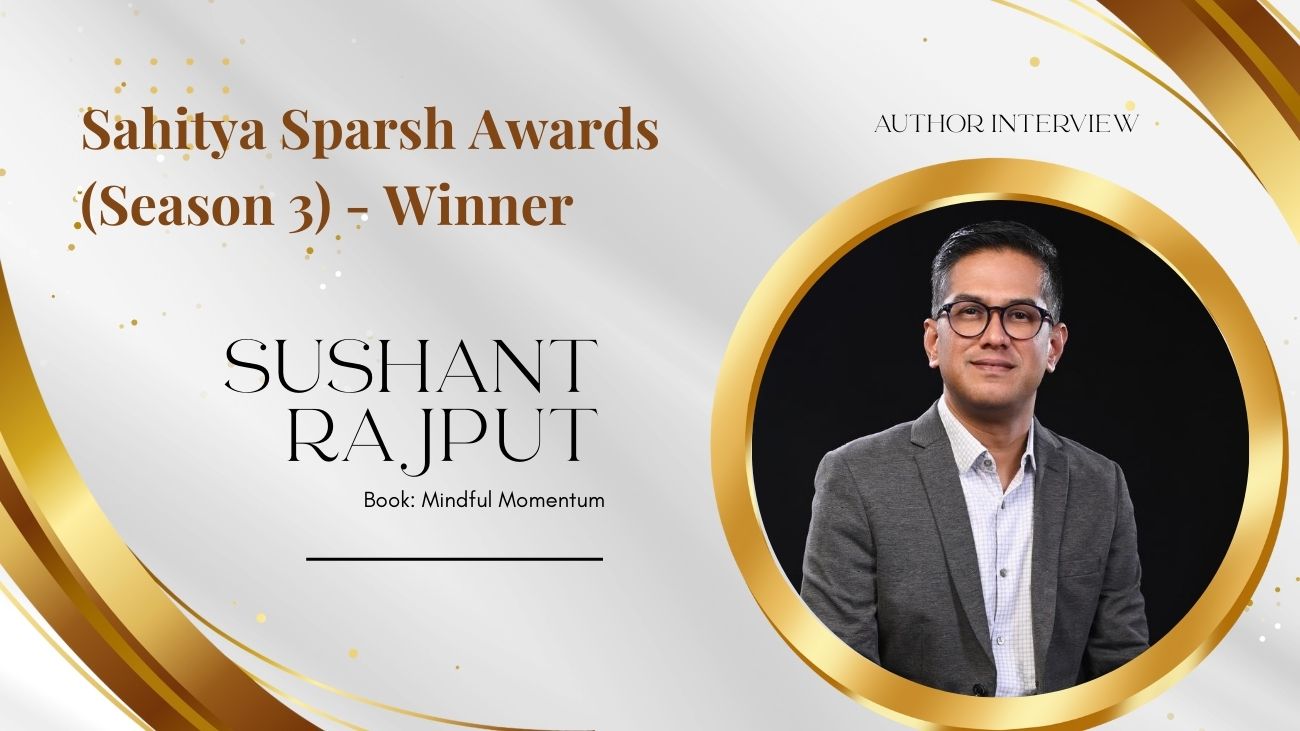
Interview Responses – Sahitya Sparsh Award (Season 3)
1. Congratulations on your book release and winning the Sahitya Sparsh Awards – Season 3! How does it feel to receive such recognition?
Winning the Sahitya Sparsh Award for Best Book in Productivity and Management is deeply humbling. Mindful Momentum was born out of lived experiences, quiet struggles, and countless conversations with students and professionals who felt stuck between intention and action. To see it recognised on a national literary platform affirms that the message resonates.
For me, the award is not just a trophy, but a reminder that words have the power to shift mindsets, spark clarity, and create change. And if even one reader feels less alone in their battles with procrastination or overthinking, I consider that the real victory.
2. Mindful Momentum addresses procrastination and overthinking. What inspired you to write about these mental challenges?
Both procrastination and overthinking disguise themselves as harmless habits until one day you realise they have quietly stolen months, opportunities, and emotional peace.
I wrote this book because I watched brilliant students doubt themselves unnecessarily, young professionals lose momentum right when they needed it most and adults, including myself, delay dreams for years because “the timing wasn’t right”.
I wanted to write a book that doesn’t lecture, but guidesas a book that speaks with empathy, realism, and actionable clarity. A book that tells the reader – “Your mind is not your enemy. It just needs a better operating manual”.
3. You have a distinguished career in business and finance. How did your professional experiences influence the ideas in Mindful Momentum?
Working across investment banking, operations, business development, and transformation exposed me to a universal truth: “It’s rarely lack of talent that holds people back but it’s the inability to manage mental friction”.
I saw teams miss deadlines not because they lacked skills, but because decision paralysis consumed them. I observed high performers burn out from the weight of their own expectations.
My corporate journey taught me that productivity isn’t a spreadsheet metric; rather, it’s a behavioural one. Mindful Momentum combines this corporate exposure with psychology, neuroscience, and personal reflections to offer a truly holistic approach.
4. For readers who are new to mindfulness, how would you explain the benefits of applying mindfulness to everyday life?
Mindfulness is not meditation alone. It is the art of paying attention to your thoughts, emotions, habits, and impulses without judgement.
In daily life, mindfulness helps you:
- Notice patterns that drain your energy
- Catch procrastination before it starts
- Break loops of unnecessary worry
- Make decisions with clarity instead of panic
- Stay anchored in reality rather than racing through imagined scenarios
It brings an individual back to the only place where change is actually possibleand that is the present moment.
5. How does Mindful Momentum differ from your previous book?
My first book was a compass, a practical guide for early-career professionals trying to navigate the corporate world.
Mindful Momentum is different. It is not about career navigation alone, but about self-navigation.
Where the first book equips you with external skills, this book strengthens your internal architecture, which includes your thoughts, emotions, beliefs, discipline, and mental resilience.
It moves from “how to succeed at work” to “how to manage yourself better”.
6. Can you share a personal story where mindfulness helped you?
During the early stages of writing this book, I kept delaying one particular chapter. Every time I sat down, I felt the pressure to make it perfect. Weeks passed.
One morning, I asked myself a simple mindful question: “What am I really avoiding?”
The honest answer was fear of not writing it well enough. Recognizing that shifted everything. I stopped focusing on perfection and decided to simply show up for 30 minutes without judgement. That day, I wrote five pages.
Mindfulness didn’t solve the problem; it solved the story I was telling myself about the problem.
7. Common misconceptions addressed in your book:
Three big misconceptions stand out:
- “Procrastination means you’re lazy” – No, it isn’t; it usually means you are overwhelmed, afraid, or unclear.
- “Overthinking is a sign of intelligence” – Not always. True intelligence is the ability to stop thinking when necessary.
- “I will take action when I feel motivated” – Motivation is unreliable; discipline built on clarity is what sustains momentum.
Both challenges are psychological feedback, not character flaws.
8. Are you active on social media?
Yes, I actively share insights, reflections, book updates, and career guidance across platforms. Readers can connect with me on:
- Instagram: @dr_sushant_rajput3117
- LinkedIn: Dr. Sushant Rajput
I’m always happy to interact with readers, students, and professionals who resonate with the themes of growth, clarity, and purpose.
9. Where can readers purchase your books?
Available on Amazon (India & International), Flipkart, and Notion Press Store.
Both my books, Mindful Momentum and I Wish Someone Told Me This Before My First Job, are available on Amazon (India & International) and Flipkart.
The Kindle editions are perfect for readers who prefer a digital format, while the paperback has been designed for those who enjoy reflective reading with annotations.
10. One simple exercise:
A powerful yet simple exercise is the “One-Moment Rule”.
Whenever you feel stuck, instead of saying “I’ll start tomorrow”, say:
“I will do this for just one moment, one minute, one paragraph, one small step”.
Momentum is born not from big leaps, but from tiny, consistent beginnings. The moment you start, resistance loses its power.
11. Impact of your books:
Professionals and students today are not struggling with capability; they are struggling with mental bandwidth. In a world full of constant comparison, digital noise, and relentless pace, clarity has become a rare luxury.
Books like Mindful Momentum act as quiet companions which simplify inner chaos, provide frameworks for reflection, and help readers reclaim control over their day-to-day decisions and emotional life.
If this book gives someone the courage to take the first step, the clarity to pause, or the belief that they can rebuild themselves, its purpose is fulfilled.
12. Advice for aspiring authors:
Write only if you’re willing to be honest. Self-help is not about giving solutions; it is about sharing truths.
A few things I told myself when I began writing:
- Speak from experience, not theory
- Respect your reader’s intelligence
- Don’t preach; rather, share
- Make it simple, but never superficial
- And most importantly, write the book you yourself needed at some stage of life
When writing comes from a place of authenticity, it naturally finds the people who need it.