
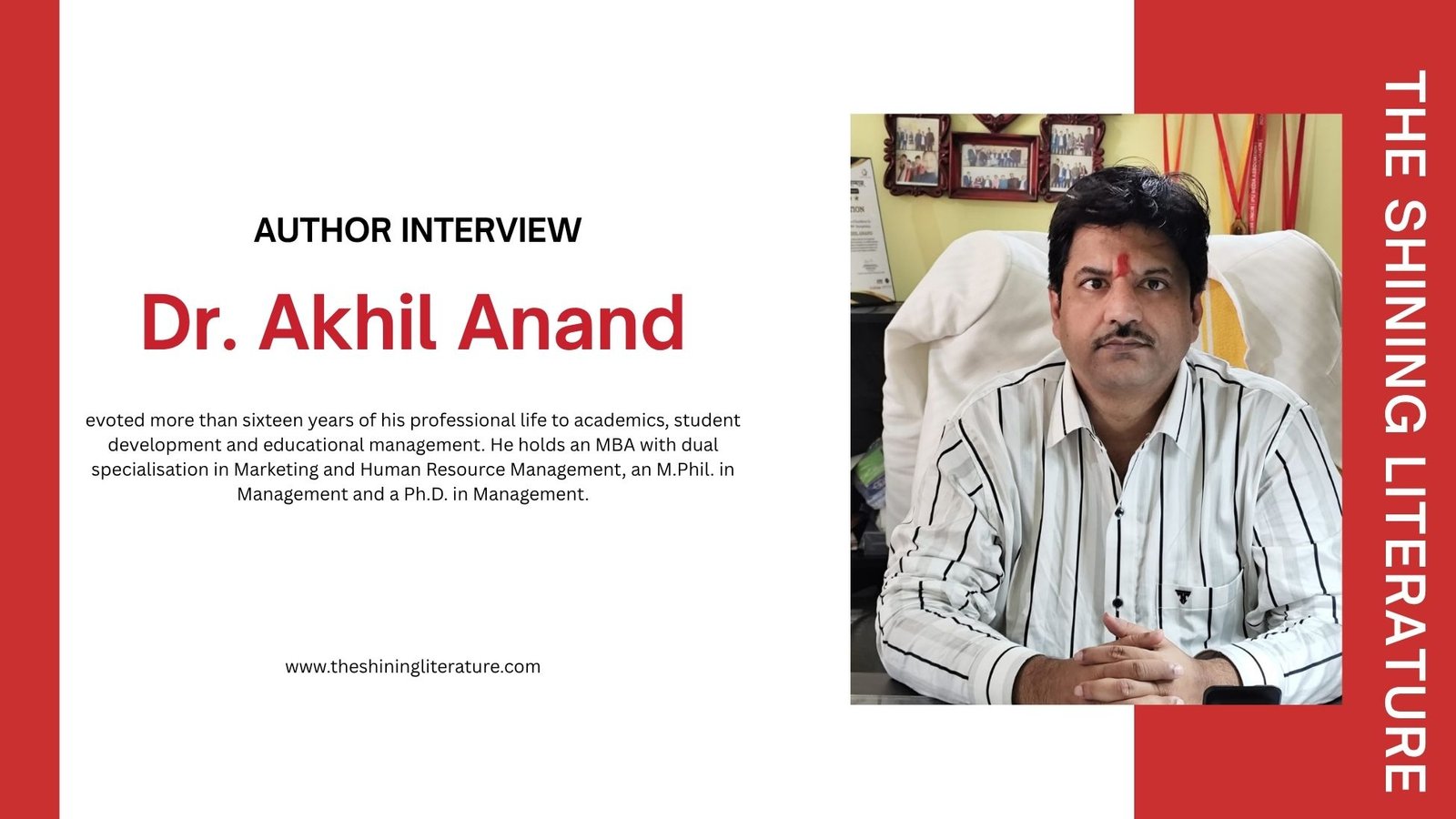
Dr. Akhil Anand | M.B.A. • M.Phil. • PhD
Academician • Entrepreneur • Author
Q1. What inspired you to write Age Doesn’t Earn The Chair: When Indian Sanskar Meets Professional Reality?
In India, we grow up hearing, “Respect your elders.” I agree wholeheartedly. But somewhere between the family dining table and the office conference table, a small misunderstanding enters: we begin treating respect as a lifetime subscription to being right!
Imagine a school meeting. A young teacher suggests a digital attendance system. A senior colleague replies, “We have used registers for twenty-five years.” Fair enough—but twenty-five years of using a register does not prove that a faster system is wrong. It proves the register has enjoyed a very long career!
My years in education and entrepreneurship exposed me to this tension: tradition can teach us how to behave, but it cannot replace evidence about what works. I wrote this book to separate respect for a person from automatic acceptance of every decision.
The central question is simple: If we can respectfully disagree with an elder at home about which route to take, why must professional disagreement become an insult?
Q2. The title of your book is quite thought-provoking. What message do you want readers to understand from it?
The “chair” in my title is not a piece of furniture. It is a symbol of trust. A chair does not ask for your birth certificate; it asks whether you can carry the responsibility placed on it.
Consider two applicants for a principal’s position. One has thirty years of service but resists feedback. The other has twelve years of experience, strong results, and the ability to build a team. The fair choice is not automatically the older or the younger candidate. It is the candidate who can lead that particular institution well.
We would never appoint a cricket captain merely because he owns the oldest bat. Why should professional leadership work differently?
My title challenges entitlement, not elders. Seniority can be evidence of experience; it should not be a substitute for evaluation.
Q3. In Indian society, respecting elders is deeply rooted in our culture. How can we balance this tradition with professional competence and accountability?
The balance begins with a distinction: dignity is non-negotiable; decisions are discussable. You can touch an elder’s feet at a family gathering and still ask for data at a management meeting. Neither action cancels the other.
Suppose a senior teacher insists on a teaching method that leaves students confused. A younger academic coordinator should not say, “You are outdated.” Instead: “Your classroom experience is valuable. May we compare learning outcomes from both methods over four weeks?” Now the debate moves from age to student benefit.
Our sanskar should make disagreement more courteous, not make it impossible. A workplace needs both a respectful tone and a functioning question mark.
Respect the individual fully. Test the idea fairly. Judge the outcome honestly.
Q4. Do you believe that age and experience automatically make someone a better leader? Why or why not?
No. Age measures how long we have lived; experience describes what we have encountered; leadership shows what we can responsibly do with what we have learned. These are related, but they are not identical.
Picture two drivers. One has driven the same road for thirty years. Another has driven for ten years, learned new safety systems, and adapts calmly to changing conditions. The first may know every pothole; the second may navigate new technology better. The safest journey may come from combining both strengths.
A leader who says “I have thirty years of experience” deserves a follow-up question: “What did those years teach you—and what have you changed because of them?” Repeating one year thirty times is not necessarily thirty years of growth.
The best leader is neither the youngest voice nor the oldest voice. It is the person who knows when to listen, decide, and take responsibility.
Q5. Your book draws inspiration from the Bhagavad Gita, Mahabharata, Ramayana, and Chanakya’s teachings. How have these traditional sources influenced your understanding of modern leadership?
Our classical traditions are not museum pieces; they are invitations to think about duty, ego, judgment, and consequences. I draw leadership lessons from the Bhagavad Gita’s emphasis on duty, the Mahabharata’s moral dilemmas, the Ramayana’s portrayals of commitment and responsibility, and the strategic thinking associated with Chanakya. These are interpretations for modern work, not claims that ancient texts contain ready-made HR manuals!
For instance, the Mahabharata repeatedly shows how loyalty and attachment can complicate judgment. A modern parallel arises when a family business must choose between appointing a relative and selecting the most capable manager. Affection belongs in the family; job criteria belong in the selection process.
The lesson is not to discard tradition. It is to avoid using tradition as a convenient shield for ego. Values should sharpen our judgment—not switch it off.
Q6. What are some of the most common challenges younger professionals face when working under or managing senior colleagues?
A young professional’s biggest difficulty is often that an idea is judged by the speaker’s age before anyone hears the idea. “You were still in school when I joined!” may be historically accurate, but it is not a business argument.
Imagine a 28-year-old vice principal proposing a new parent-communication system to a 55-year-old colleague. The younger leader may fear appearing disrespectful; the senior colleague may fear losing status. Both fears are understandable. Neither should decide the policy.
My advice to the younger person: arrive with evidence, invite questions, and acknowledge what you have not yet learned. My advice to the senior person: test the proposal on merit rather than treating every suggestion as a challenge to your identity.
A younger boss does not become a better human being by becoming the boss. And a senior employee does not lose dignity by learning something new.
Q7. With more than sixteen years of experience in academics and educational management, have you personally encountered situations that inspired the ideas discussed in this book?
Certainly. More than sixteen years in academics and educational management have taught me that a designation is printed in minutes, while credibility is built over years. I have seen how people can differ greatly in initiative, adaptability, and commitment even when their résumés look equally impressive.
Consider a hypothetical school situation: an experienced teacher knows the subject deeply but struggles with a new assessment platform. A younger teacher handles the platform effortlessly but misses a subtle learning difficulty in a student. If I reward only digital speed, I lose wisdom. If I reward only tenure, I lose innovation. A sensible leader pairs them and evaluates results.
I must apply the same standard to myself. When a team member disagrees with me, am I examining the idea—or defending my chair? A director who demands accountability from everyone except himself has turned leadership into a one-person exemption scheme.
Leadership starts when the mirror becomes as important as the meeting room.
Q8. How can organisations create a workplace culture where both younger and older employees feel equally respected and valued?
First, write down what each role must deliver. If expectations are vague, personal preferences quietly become performance criteria. Second, assess people with observable evidence. Third, make learning travel in both directions.
Imagine a monthly “skills exchange”: a veteran teacher demonstrates how to handle a difficult classroom discussion; a younger teacher demonstrates how to create an effective digital quiz. Nobody is crowned the “modern genius” or dismissed as the “old-school dinosaur.” Both contribute.
A fair organisation also creates a safe way to disagree: challenge proposals in meetings, not people’s dignity; give feedback privately when possible; and explain decisions openly.
A healthy workplace is not a choir in which everyone sings the director’s favourite song. It is an orchestra: different instruments, one shared purpose, and enough discipline to avoid noise.
Q9. In your opinion, what qualities should define a good leader beyond age, seniority, and professional designation?
I would choose integrity, judgment, emotional control, curiosity, fairness, and the courage to own mistakes. Technical competence matters, but character decides what happens when competence is tested.
Take a school event that goes badly. One leader immediately asks, “Who is responsible?”—usually meaning “Who can I blame?” Another asks, “What failed, what was my part, and how do we prevent it next time?” The second response builds trust without abandoning accountability.
I also believe leaders must control their tone. A correct decision delivered with unnecessary humiliation can create resistance to the very improvement we want. Being firm is useful; being frightening is not a performance metric.
A title on a visiting card can introduce a leader. Only conduct can persuade people to follow.
Q10. Your book explores examples from corporate offices, educational institutions, hospitals, and family businesses. Which sector do you believe faces the greatest challenges in balancing seniority with merit?
Family businesses may face the most emotionally complicated version of this problem, although every sector has its own risks. In a family firm, an organisational chart can look suspiciously like a family tree. “He is your uncle” may be a wonderful reason to offer him tea; it is not, by itself, a reason to put him in charge of cybersecurity.
In hospitals, hierarchical hesitation can delay useful questions. In companies, tenure may overshadow current capability. In schools, seniority may be confused with teaching effectiveness. Each sector therefore needs clear responsibilities, open communication, and fair assessment.
Education deserves particular care because children observe how adults exercise authority. If we tell students to think critically but punish teachers for asking thoughtful questions, we are teaching two contradictory lessons in the same building.
The solution is not to remove emotion from human relationships. It is to stop emotion from secretly replacing professional criteria.
Q11. What advice would you give to young professionals who struggle to express their opinions or challenge decisions made by senior colleagues while maintaining respect?
Prepare before you disagree. Know the facts, understand the senior colleague’s concern, and offer a workable alternative. The sentence “You are wrong” often closes a conversation. “May I show you what the numbers suggest?” may open one.
Suppose your manager insists on printing 500 circulars, while most parents use digital communication. Do not begin with “Nobody prints anymore!” Say, “Could we send digital notices first, keep printed copies for families who need them, and compare reach and cost?” That proposal respects both accessibility and efficiency.
Choose the right setting. A private discussion may protect dignity, while a documented team review may be needed for important decisions. And remember: respectful disagreement is not surrender.
You do not need to increase your volume to increase the strength of your argument. Evidence is often a better microphone.
Q12. Finally, what is the one important lesson you hope readers will take away after reading Age Doesn’t Earn The Chair, and what message would you like to share with aspiring leaders and professionals?
I hope readers remember that respect belongs to every human being, while authority must be justified by competence, character, and accountability. The youngest employee is not automatically a revolutionary, and the oldest is not automatically a philosopher. People are more complicated—and more valuable—than their age brackets.
Imagine a workplace where a 60-year-old expert says, “Teach me that new tool,” and a 25-year-old colleague says, “Teach me how you handle that difficult client.” Neither loses status; both gain capability. That is the culture I want to encourage.
My message to aspiring leaders is this: do not chase the chair as a trophy. Prepare to carry its responsibilities. Share credit, accept correction, and keep learning even when nobody can order you to.
A chair has four legs. Good leadership needs at least four supports too: competence, integrity, humility, and accountability. Remove one, and the occupant may discover gravity faster than wisdom.
FINAL MESSAGE FROM THE AUTHOR
I am not against age; I am against treating age as an automatic answer. I am not against tradition; I am against using tradition to silence talent. And I am not against authority; I am against authority without accountability.
Let us respect our elders, encourage our younger colleagues, test ideas fairly, and remember: the chair is not a birthday gift. It is a responsibility.
— Dr. Akhil Anand