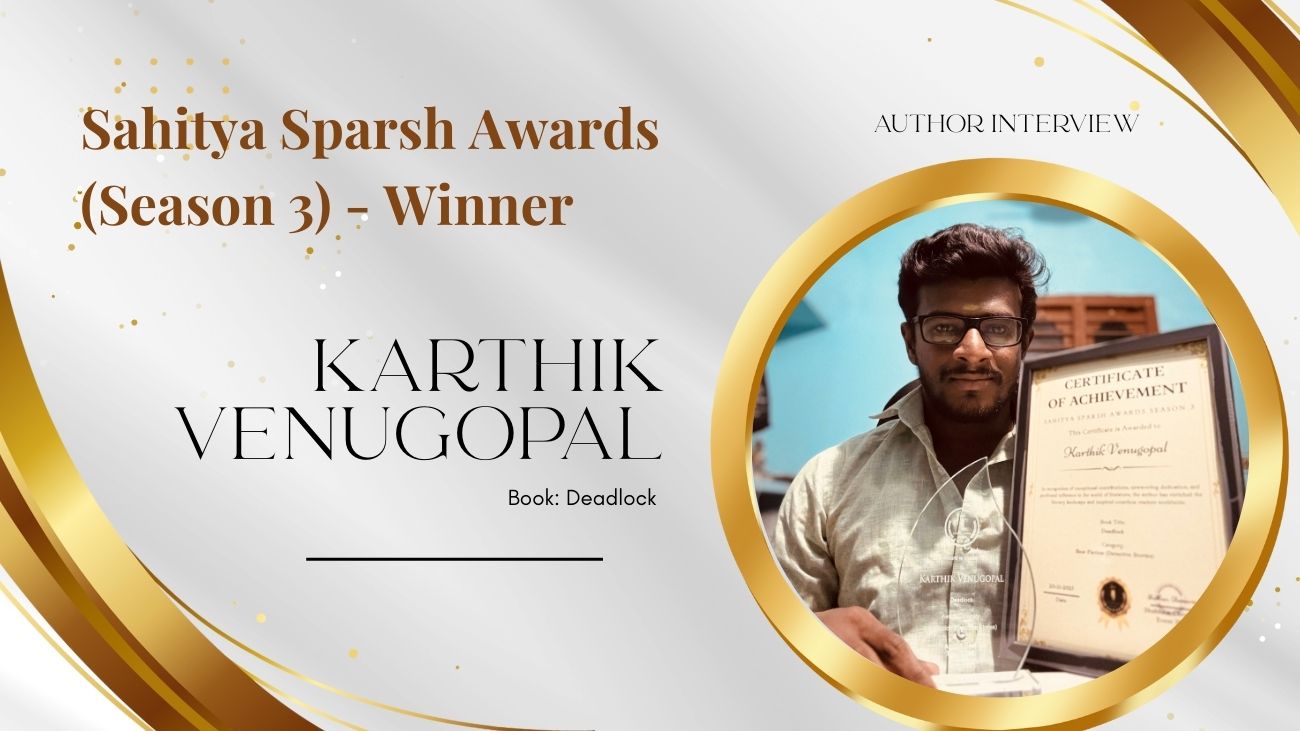
Interview – Karthik Venugopal
1. Congratulations on the release of Deadlock and winning the Sahitya Sparsh Awards Season 3 in the Best Fiction (Detective Stories) category. How does it feel to receive this recognition?
Thank you so much. Winning the Sahitya Sparsh Award is deeply humbling. Deadlock began as a quiet idea born out of curiosity about the human mind, and seeing it resonate with readers and jurors alike is incredibly rewarding. This recognition reassures me that stories rooted in psychological depth and purpose still matter.
2. What inspired you to write Deadlock, and how did your journey as an author begin?
Deadlock was inspired by my fascination with psychological conflict, especially the thin line between justice and obsession. My journey as an author began organically. Storytelling was always my way of making sense of complex emotions, human behavior, and moral dilemmas. Writing gradually evolved from passion to purpose.
3. Your background is in both engineering and law. How have these disciplines influenced your writing style and storytelling approach?
Engineering trained my mind to think structurally and logically, while law exposed me to real human conflicts, moral ambiguity, and psychological tension. Together, they help me create stories that are both intellectually precise and emotionally grounded. Deadlock reflects this balance, structured plots with deeply human characters.
4. The character of Detective Max is compelling and complex. How did you develop him, and is he inspired by anyone from your personal or professional life?
Detective Max was developed as a deeply human character, brilliant yet flawed, disciplined yet vulnerable. He is not inspired by a single person but rather by the collective traits I have observed in professionals who operate under extreme pressure. His internal struggles make him relatable, not just heroic.
5. Deadlock involves intricate riddles and psychological twists. How did you research and craft these suspenseful elements?
The riddles were carefully designed to serve both the plot and the psychology of the antagonist. I studied criminal psychology, symbolic language, and classic puzzle structures. Each riddle is not just a clue, it is a reflection of the criminal’s mindset and an emotional test for Detective Max.
6. As a lawyer, you encounter real life stories and human experiences. How do these experiences shape the themes and characters in your books?
Law exposes you to raw human emotions, fear, guilt, resilience, injustice. These experiences naturally find their way into my writing. They help me create characters who feel real and situations that feel authentic rather than exaggerated or cinematic.
7. Do you see writing as a form of social commentary, personal expression, or both? How do you balance entertainment with deeper messages?
Definitely both. Writing is personal expression at its core, but meaningful stories inevitably become social commentary. In Deadlock, I explore obsession, power, morality, and institutional blindness, themes that quietly reflect real societal issues without preaching.
8. Are you active on social media, and how can readers connect with you or follow your work?
Yes, I actively engage with readers through social media platforms. I enjoy meaningful discussions about books, psychology, law, and storytelling. Readers can follow my journey, share their interpretations, and connect with me directly through these platforms.
Instagram: @selfikart
9. Where can readers purchase your books, and are there any upcoming projects you would like to share?
Deadlock is available on Amazon and selected bookstores. As for upcoming projects, I am currently working on another psychological thriller that dives even deeper into moral ambiguity and human vulnerability. I am excited to share more very soon.
10. What challenges did you face while writing Deadlock, and how did you overcome them?
The biggest challenge was maintaining psychological realism while keeping the narrative gripping. It required patience, multiple rewrites, and emotional discipline. I overcame it by trusting the story and allowing characters to evolve naturally rather than forcing plot twists.
11. Many readers are curious about your writing routine. Do you have a specific process or schedule when crafting your novels?
I do not follow a rigid schedule, but I am very disciplined when I write. I prefer focused, distraction free sessions where I can fully immerse myself in the story. Consistency matters more to me than fixed hours.
12. Finally, what advice would you give to aspiring writers who want to create gripping, award winning fiction like yours?
Write with honesty, not trends. Focus on depth, not speed. Read widely, observe people closely, and never underestimate the power of rewriting. Awards are outcomes, not goals. If your story is truthful and well crafted, recognition will eventually follow.