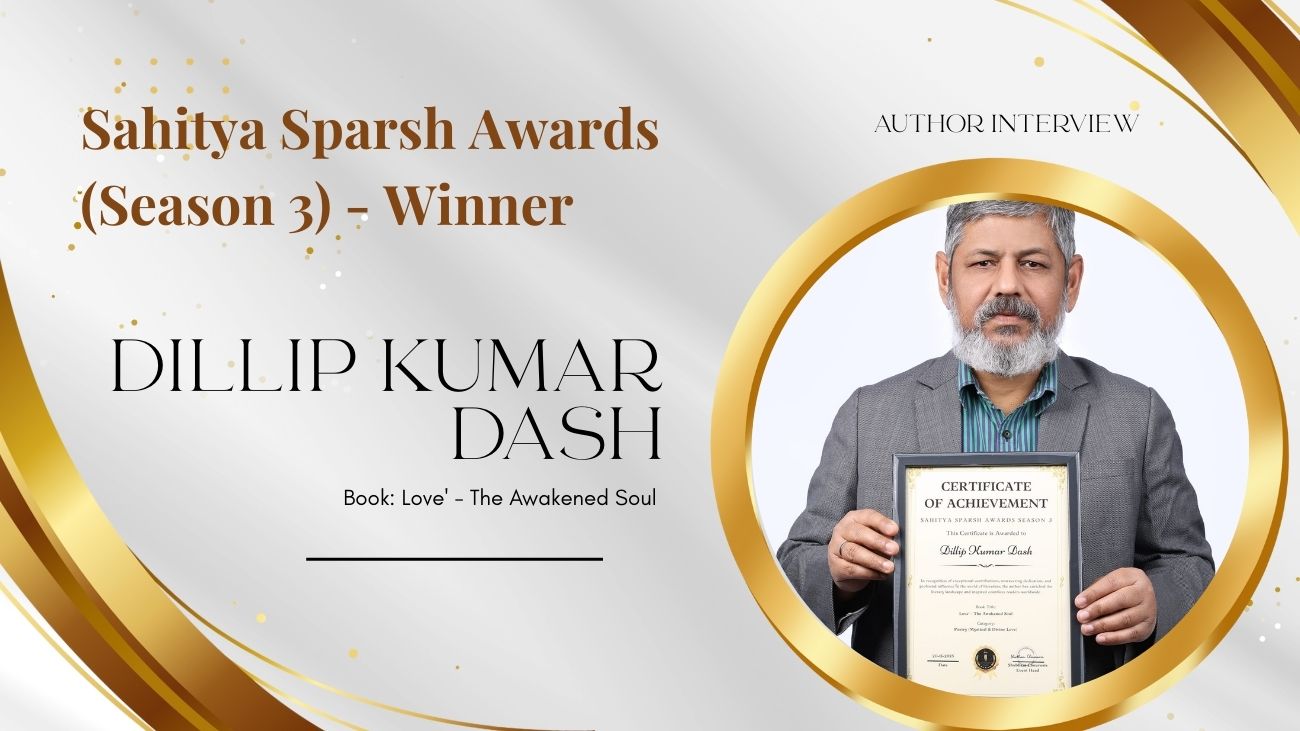
Interview – Dillip Kumar Dash
1. Congratulations on the release of your latest book, Love The Awakened Soul, and on winning the Sahitya Sparsh Awards Season 3. How does it feel to receive this recognition?
Every gift of the Almighty is precious; there is nothing small or big. Every bit of eternity is vast in this unfathomable universe. Hence, the Sahitya Sparsh Award Season 3 is special to me, my feelings, and all those who know or do not know me.
2. Your work spans poetry, psychological literature, and technical books. How do you balance your medical career with your literary pursuits?
For me, psychiatry is my entire life, and literature and poetry are its essence. Apart from my working hours of almost nine hours a day, I write and read for about two hours daily. Psychiatry for me is not just about medicaments; it is a permutation and combination of prose and poetry.
3. What inspired you to write Love The Awakened Soul, and what message do you hope readers take away from it?
The inspiration for writing Love The Awakened Soul comes from my own eternal feelings. The teachings of the great Osho guide all my mystical writings, including this book.
4. Many of your books explore mystical and divine themes. How has your background in psychiatry influenced your approach to writing poetry?
Psychiatry roots in psychology.
Psychology roots in philosophy.
Philosophy roots in mysticism and poetry.
5. Your poetry often blends Sufism, meditation, and spirituality. Can you share the process or practice behind creating such reflective works?
As a psychiatrist, the mind resides in different areas of the brain’s grey and white matter. But as a counsellor and poet, psychiatry always resides in the four chambers of my heart.
6. For readers who are new to your work, which of your books would you recommend starting with and why?
- Innerpath: The Essentials
- Talking to Self
These two books are very simple and are explained step by step in a semi poetic way.
7. Are you active on social media, and how can readers connect with you to follow your literary journey?
I do not have much time for social media, so I am not very active on these platforms.
8. Where can readers purchase your books, both online and offline? Are there any special editions or translations they should look for?
My books are available on many online bookstores as well as on the publisher’s website. One of my books, out of eight, has been translated from English into Hindi.
9. You have authored both Hindi and English books. How does writing in different languages shape the themes or expressions in your work?
The essence is one; the medium of expression is different. It is a little difficult, but it is not a major issue.
10. As a poet and a mental health professional, what role do you think literature and poetry play in healing and self discovery?
The answer lies in your question itself. I have already explained that without poetry in psychiatry, the practice of psychiatry would not be self satisfying.
11. Can you share any memorable feedback or experiences from readers that deeply touched you?
A. The review of my book Talking to Self by Kirkus Review, Texas, gave a fantastic response.
B. I presented Talking to Self to Dr. Thomas Brod, a psychiatrist from California. He read two lines from the book and tears came to his eyes. Those lines were:
“Flowers and bees from different geography silently speaking to a musician, we are from the same planet.”
12. Finally, what advice would you give aspiring poets and writers who want to combine spiritual themes with literature?
Practice silence every day whenever possible, with no fixed time or place, and remain comfortable with yourself. Let the flow of your emotions spread naturally. Do not worry.