
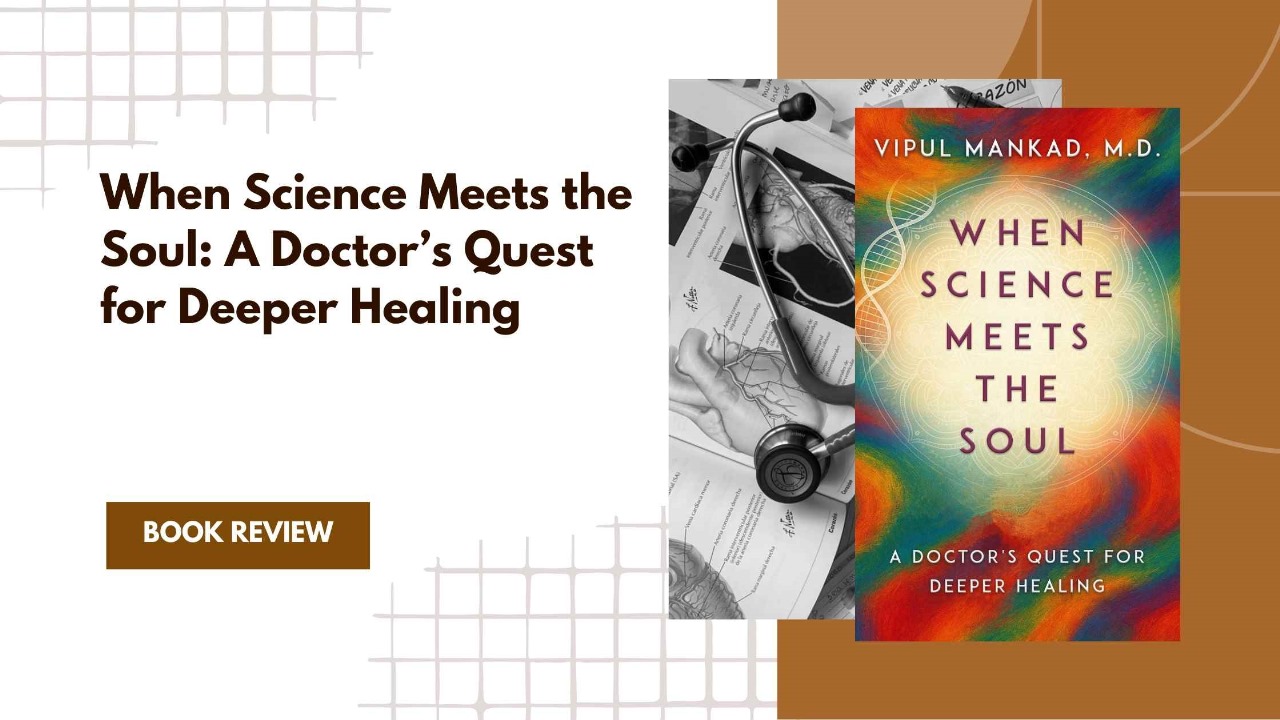
Book Review: When Science Meets the Soul: A Doctor’s Quest for Deeper Healing by Vipul Mankad, M.D.
When Science Meets the Soul: A Doctor’s Quest for Deeper Healing is an ambitious, reflective, and deeply personal work that bridges modern biomedical science with timeless philosophical inquiry. Written by Dr. Vipul Mankad—an internationally recognized physician, scientist, and former academic leader—the book invites readers to explore one of humanity’s oldest and most profound questions: Who am I? In doing so, it challenges the dominance of external labels and achievements and urges a return to inner awareness as the foundation of a balanced and meaningful life.
At its core, this book is not merely a memoir, nor is it a conventional self-help guide. Instead, it is a thoughtful synthesis of lived experience, scientific rigor, cultural analysis, and spiritual wisdom. Dr. Mankad draws from a remarkable life journey that spans continents, cultures, and disciplines, using his story as a lens through which readers can examine their own assumptions about identity, success, suffering, and healing.
One of the book’s greatest strengths lies in its exploration of how cultural and social forces shape the individual. Dr. Mankad thoughtfully examines the influence of family, neighborhood, country, and historical migration on the development of the body, mind, beliefs, and behavior. He emphasizes the interplay between nature and nurture—our genetic inheritance and our environment—and how these forces contribute to the superficial descriptors society often uses to define us: age, gender, race, profession, education, and material wealth. While these descriptors may be socially useful, the author argues persuasively that they also fuel comparison, discrimination, conflict, and even war.
What distinguishes When Science Meets the Soul is its insistence that true healing and mental balance arise from going beyond these external identities. Dr. Mankad introduces the idea of a “pure consciousness” that exists beneath the body-mind machine—a universal inner self that transcends cultural and social conditioning. By reconnecting with this deeper dimension of being, individuals can free themselves from limiting labels, reduce inner turmoil, and live what the author repeatedly calls a “Good Life.”
Dr. Mankad’s credibility as both a scientist and a spiritual seeker gives the book a rare authenticity. His professional accomplishments are extraordinary: NIH-funded research equivalent to tens of millions of dollars, over 150 scientific publications, leadership roles in pediatrics, and the founding of a children’s hospital. Yet he is refreshingly candid about the personal cost of these achievements. The book does not shy away from the emotional burden of caring for children with life-threatening illnesses or the pain of encountering discrimination and professional “glass ceilings,” even within a meritocratic system.
These challenges serve as a turning point in the narrative. Faced with emotional exhaustion and systemic barriers, Dr. Mankad turns inward, drawing upon ancient Indian philosophy, Western thought, and meditation practices to restore mental equilibrium. Rather than presenting spirituality as an escape from reality, he frames it as a practical and necessary tool for navigating a turbulent world. This grounded approach makes the book particularly compelling for readers who may be skeptical of purely abstract or dogmatic spiritual texts.
Another notable feature of the book is its emphasis on self-inquiry and personal responsibility. Dr. Mankad does not claim to offer definitive answers to life’s deepest questions. Instead, he provides self-assessment tools and reflective exercises that encourage readers to embark on their own journey of discovery. This approach reinforces the book’s central message: truth cannot be handed down fully formed; it must be experienced and realized individually.
The writing style is clear, thoughtful, and accessible, even when addressing complex ideas from philosophy, neuroscience, or psychology. Anecdotes from Dr. Mankad’s life—his immigration from India at age 23, his training across elite medical centers in the U.S. and England, and his global travels—bring warmth and humanity to the text. These stories serve not as self-promotion, but as illustrations of universal struggles with identity, belonging, and purpose.
When Science Meets the Soul will resonate with a wide audience: healthcare professionals grappling with burnout, scientists seeking meaning beyond data, immigrants navigating cultural dislocation, and readers simply searching for inner balance in an increasingly polarized world. While the book is intellectually rich, its ultimate value lies in its compassion and wisdom. Dr. Mankad reminds us that healing is not limited to curing disease; it also involves understanding ourselves more deeply and living with clarity, humility, and balance.
In summary, When Science Meets the Soul: A Doctor’s Quest for Deeper Healing is a thoughtful and inspiring contribution to the growing dialogue between science and spirituality. It challenges readers to look beyond external success and societal labels and to reconnect with the inner consciousness that unites us all. For those willing to reflect honestly and engage deeply, this book offers not just insights, but a meaningful path toward a Good Life.