
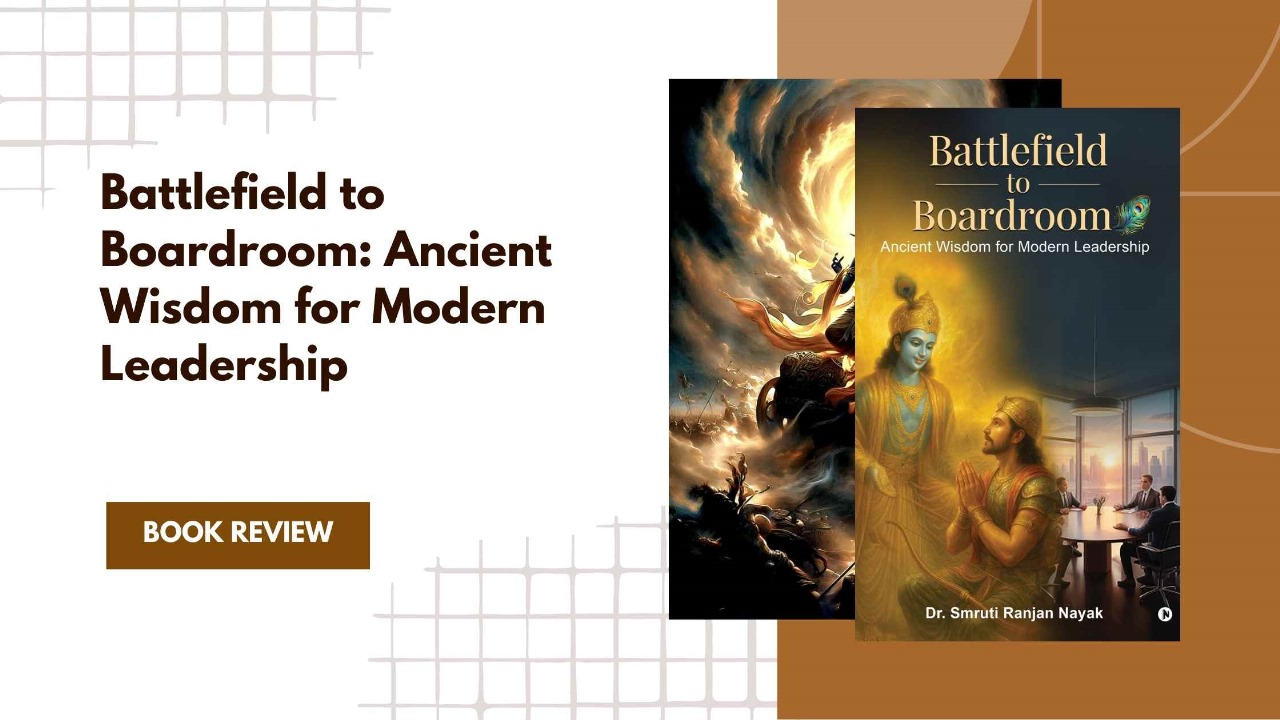
Battlefield to Boardroom: Ancient Wisdom for Modern Leadership – A Review
Battlefield to Boardroom: Ancient Wisdom for Modern Leadership by Dr. Smruti Ranjan Nayak is not merely a leadership book; it is a contemplative journey that bridges millennia, cultures, and contexts. Rooted in the timeless wisdom of the Bhagavad Gita and interpreted through the lens of modern management, the book offers a profound response to a question that haunts today’s leaders: how to lead with clarity, courage, and conscience in an age defined by volatility, pressure, and ethical ambiguity. Dr. Nayak invites readers to look beyond conventional leadership playbooks and rediscover insights that were first spoken on a battlefield, yet remain strikingly relevant in boardrooms across the world.
At the heart of the book lies a powerful premise: the dilemmas faced by modern leaders are not new. Uncertainty, fear of failure, conflict between duty and desire, pressure to perform, and moral confusion have always accompanied positions of responsibility. By drawing parallels between Arjuna’s existential crisis on the battlefield of Kurukshetra and the inner conflicts of today’s executives, entrepreneurs, and managers, the author reframes leadership as an inner discipline before it becomes an external role. Leadership, in this sense, is not about control or authority but about awareness, alignment, and purposeful action.
Dr. Nayak’s strength lies in his ability to translate ancient philosophy into accessible, actionable insights without diluting its depth. The Bhagavad Gita is often revered, quoted, or spiritualized, but rarely operationalized in the context of modern organizations. Battlefield to Boardroom succeeds precisely because it avoids superficial analogies and instead offers structured frameworks that connect timeless wisdom with contemporary strategy, decision-making, and people management. The author’s pioneering concept of the “Gita Grid” stands out as a thoughtful attempt to systematize ethical clarity, strategic thinking, and emotional resilience into practical leadership tools.
One of the most compelling aspects of the book is its treatment of pressure. In an era obsessed with outcomes, metrics, and relentless performance, leaders are often trapped in anxiety about results. Drawing from the Gita’s emphasis on karma yoga—action without attachment to outcomes—Dr. Nayak challenges the dominant narrative of success. He does not argue against ambition or excellence; rather, he reframes them. True leadership excellence, according to the book, emerges when leaders act with integrity, skill, and focus, while remaining detached from ego-driven rewards or fear-driven consequences. This shift from outcome obsession to purpose-driven action feels both radical and deeply liberating.
Equally impactful is the book’s exploration of ethical leadership. Instead of presenting morality as a constraint, Battlefield to Boardroom positions values as a strategic advantage. In times of crisis, ethical clarity becomes a source of trust, resilience, and long-term sustainability. Dr. Nayak argues convincingly that organizations guided solely by profit eventually erode their own foundations, whereas those anchored in principle generate enduring impact. The book’s narrative makes it clear that ethics is not a soft skill or an optional add-on, but the very backbone of effective leadership.
The author’s background as an Oxford and Harvard educated management professional is evident in the book’s balance of scholarship and practicality. While the philosophical roots are ancient, the language remains contemporary, relatable, and grounded in real-world leadership challenges. The book speaks equally to CEOs navigating complex strategic decisions, entrepreneurs wrestling with uncertainty, managers leading diverse teams, and seekers searching for meaning in their professional lives. This wide relevance is one of the book’s greatest strengths.
Another notable dimension of Battlefield to Boardroom is its emphasis on self-leadership. Dr. Nayak repeatedly underscores that organizations do not transform unless leaders do. The battlefield, in this sense, is internal—marked by fear, doubt, ambition, and ego. By addressing these inner conflicts, leaders can move from reactive behavior to conscious choice. The book encourages readers to pause, reflect, and realign, making leadership not just a function of position but a state of being.
Stylistically, the book maintains a reflective and inspiring tone without slipping into abstraction or moral preaching. The writing is thoughtful, confident, and purposeful, mirroring the very leadership qualities it advocates. Rather than offering quick fixes or motivational slogans, it invites sustained reflection and inner work, making it particularly valuable for readers willing to engage deeply with its ideas.
In conclusion, Battlefield to Boardroom: Ancient Wisdom for Modern Leadership is a rare contribution to the leadership literature—one that transcends trends and speaks to the timeless core of human decision-making and responsibility. Dr. Smruti Ranjan Nayak has crafted a work that is as much about awakening as it is about leading. It does not merely teach leaders how to perform better; it challenges them to become wiser, more courageous, and more humane. For anyone seeking to navigate stress with strength, pressure with purpose, and leadership with liberation, this book serves not just as a guide, but as a compass.