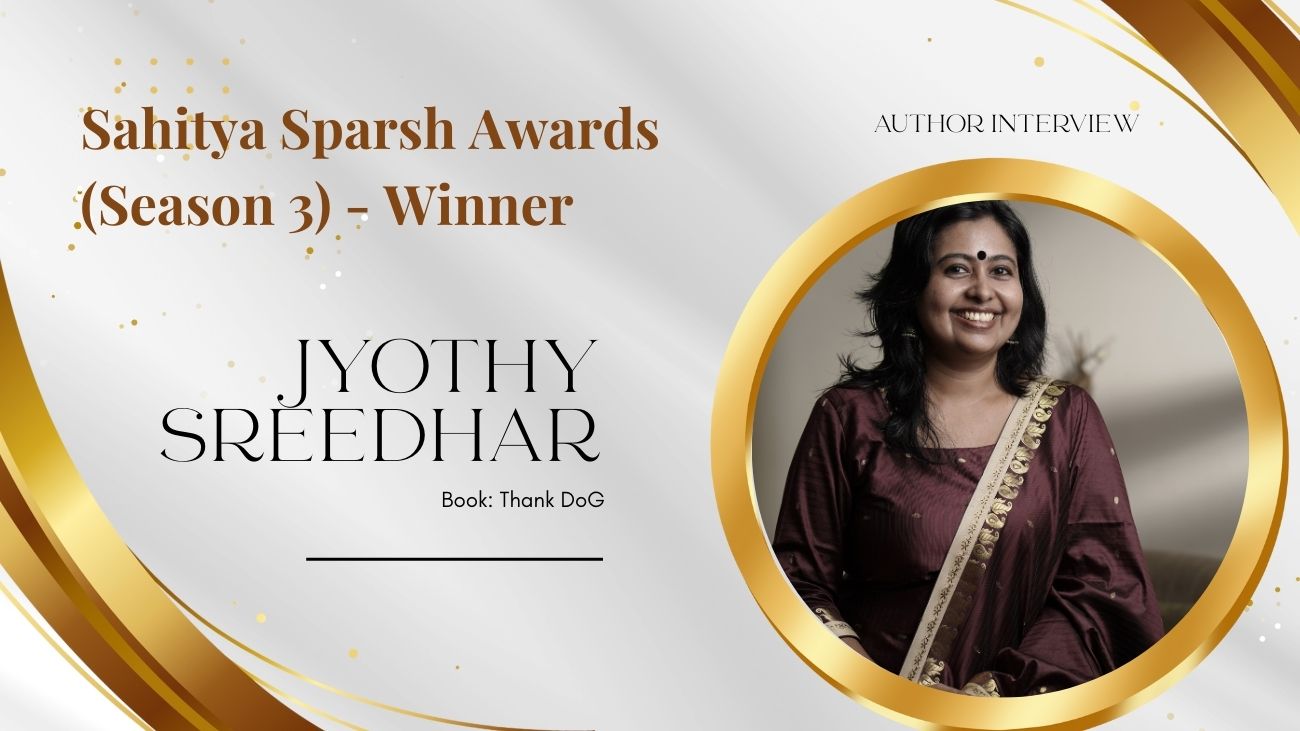
Congratulations on the release of your book Thank DoG and on winning the prestigious Sahitya Sparsh Awards – Season 3. How does this recognition feel at this stage of your writing journey?
It’s an out of the world experience. It never occurred to me that the book would go on such a grand adventure. As it wins awards, it humbles me by bringing back those memories of the difficult path I had to take for it, the struggles that led to a soothing fulfilment, the content finally after huge storms. I believe that the universe maintains equilibrium. There is always a silver lining to every cloud. Even if that were a difficult effort, the outcomes would be that good. So, these recognitions keep me going. Gratitude to universe. Humble, yet proud.
Thank DoG is a unique auto/pathographic memoir co-authored with your doctor, Dr. Mathew K. M. Puthiyidom. What inspired you to collaborate with your doctor in crafting this narrative?
Nothing about the book was pre-planned. Neither the accident, nor the book. A sudden accident, the indecisiveness, the inner conflict, the tensions, the surgery, music in the operation theatre, a surgeon singing along, the experience with bed rests and physiotherapies… which writer could keep mum about that! It was at the surgical table that I decided that I was going to write about the unique experience that I underwent. A surgeon singing along with the melodious music in the background was an assurance for me that nothing would go wrong. Originally it was written in Malayalam as a series of posts on Facebook. It got popular enough to get into popular news sites as Manorama Online. The popularity inspired me for planning a book. As I started writing it, the idea struck me that it could be narrated from the other side too, which would be something unique. As the doctor too consented to that, we decided on a journey of collaborative writing.
Your book has earned multiple world record titles. Did you anticipate such global recognition when you first began writing this memoir?
I hadn’t dared to dream of being a writer even. World records were only myths for me. It was only after I completed the book that I realized that the book is the world’s first ever memoir written collaboratively by a patient and a doctor. I researched thoroughly to confirm that as well. Later, I thought of making it official and applied for the world record titles. Yet, winning those titles was never a part of my anticipations.
You describe Thank DoG as a “fortunate accident”. Can you share how this personal experience shaped the themes and tone of the book?
Thank DoG is a story of my ‘fortunate’ accident that brought to my life the splendid twists and turns along with the recognitions. Even my literary career could be divided into two phases- one before Thank DoG and the other after it. The book became a milestone indeed for me. Just a funny thought that the accident happened because I would have wished for such a twist to happen in my literary career. If the accident would not have happened, I had ended up continuing my normal momentum in writing. But this one has been a real roller-coaster. Regarding the tone, I have made some differences in the narratological techniques to maintain the uniqueness in story-telling. The tone and techniques were put in a way that complements its theme and story.
As an Assistant Professor of English and a research scholar in health humanities, how does your academic background influence your creative writing?
That’s a big thing. Had I not been into literature or health humanities, this book would have been just a normal book. But my research on narratology and illness narratives became a foundation stone where the rest was built up. I had enough confidence to incorporate interludes, the multiple perspectives, the chats, the illustrations, irony and other literary techniques. All with that confidence. Even naming those techniques with literary terms would be an ability gifted by literature studies. When a spark gets ignited, my experience with literature helps shape it to the right form.
You have written across genres—memoir, poetry, academic writing. How do you balance these different forms, and do you have a favorite among them?
Poetry, anytime. Poetry is a vent out for me. When I get exhausted with work pressure or tensions, I feel to write poetry. When a poem gets born, my stress would have been released. It is like a boon, but a curse too. When I do not write poems for long weeks, it builds up a pressure in me. Then its like a war you wage with an army! And finally just a poetic scribble would help you shed the heaviness inside. I consider it that I lack ability in writing fiction. I can only shape something that is original. I cannot imagine a new character and give it a language of its own. So second to poetry, I like to write memoirs/life narratives. Academic writing is a necessity when I am into a mix of teaching and researching. Theoretical or critical analysis has always been part of my interests since my literature graduation days. Now it is adapted into my writing as well.
Many readers find your writing emotionally resonant and deeply introspective. What message or feeling do you hope readers carry with them after reading Thank DoG?
Accidents, illnesses, medical conditions, adverse situations and the like could happen to just anyone. No one is exceptional. Its all about how one tackles the situations and makes the best use of it. When such a challenge arises, you are left with two options. Either keep complaining (which would be easy shortcuts for the lazy ones) and speak about how you miss reverting to the earlier condition. Or you have a great option to grow with it, even if it is a fracture. You and your life grow with every fracture- be it to the bone or to your mind. I was never depressed, but was excited everytime to know what happens next. You may call me insane, and I call it my optimism. When you have a terrific positivity and excitement, life surrenders before you. Gold is made in space through immense cosmic events, which became dust on earth later on, mined from it, smelted and refined to one of the most valuable possessions through intense heat. Every occurrence in our lives is just the same.
You have authored and co-edited several books over the years. How does Thank DoG differ from your previous works in terms of process and personal significance?
Thank DoG has been a once-in-a-lifetime experience. It only owns one of the most troubled phases in my life. Thank DoG was not conceived as a normal memoir. I wanted it to be different and unique in whatever ways I could. I had never invested my knowledge of literature as much as I did in Thank DoG. Not to mention the medical condition that I had during the writing process. I was racing with my physical and mental health, only to narrate about the race itself.
Your memoir also provides insight into health humanities. Do you believe storytelling plays an essential role in healing, both for patients and healthcare professionals?
Of course yes. Every human loves to narrate and to be heard. Patients get better when they are heard. Thus evolved bibliotherapy and scriptotherapy blending literature and medicine. Think about the choice of the doctor that you make. Wouldn’t it be someone who gives you space to address the silliest issue, time to hear you, gives a smile that betters you and cheer you up with the way of communication? Health humanities makes such a deed official by terming it so. It’s about bringing health and humanities together which contribute to the overall healing of a patient. William Osler is that pioneer who made us aware about such a scope in medical studies.
Looking back, what was the most challenging part of writing such a personal narrative, and what was the most rewarding part?
My physical restraints had been challenging. I couldn’t twist or bend my left forearm well. I could not sit up for more than fifteen minutes at a stretch. I had to do long physiotherapies once in three hours. Time and ailments were real obstacles in the writing process. The most rewarding part is thinking about how huge it made into popularity and achievements.
Many of our readers would love to follow your literary journey. Are you active on social media, and how can readers reach or connect with you?
It was social media, especially Facebook, that made me a writer. Facebook has been my world since 2010. All my books had its sprouts in some of my facebook posts. My first book was officially dedicated to Facebook and my followers, with all gratitude for calling me a writer. Today, I have over two lakh followers there, along with Instagram, X, Threads, LinkedIn and a website of my own. Everywhere I am Jyothy Sreedhar, officially.
Where can readers purchase Thank DoG and your other books?
Thank DoG’s second edition was released recently, published by Writers International Edition. It is currently available on popular shopping sites including Amazon. And my books are also available in ivorybooks.in.
Thank you for answering our questions today. Before we conclude, is there anything else you would like to share with your readers or aspiring writers?
Let something from my book inspire you in a bad moment that you face. Let it lighten atleast one minute of your darkness. I wish, my dear readers, that when you remember me, you do that with a smile. To the aspiring writers, trust me, you are blessed enough to be granted the wings that help generations fly. When you become a writer, it is like the universe has something to tell the world through you. Trust your words, and the universe. You shall evolve.