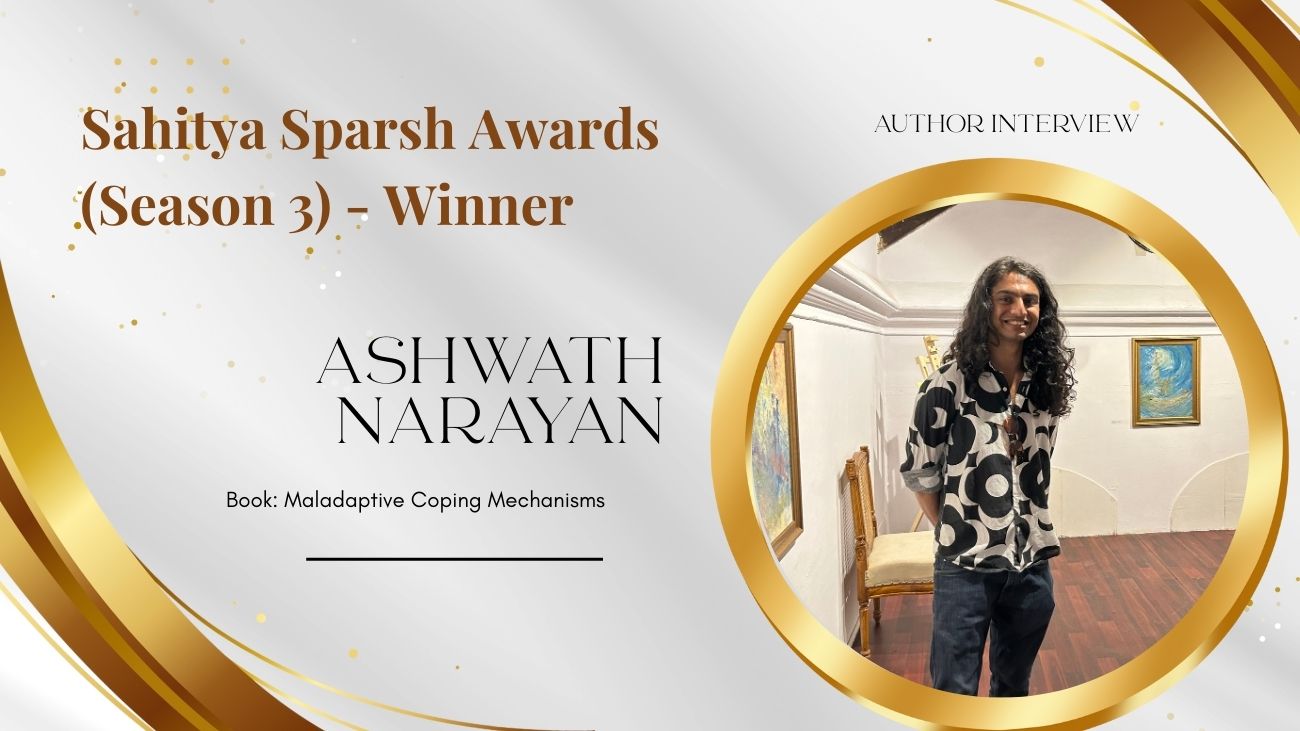
1. Congratulations on the release of Maladaptive Coping Mechanisms and on winning the Sahitya Sparsh Awards – Season 3. How does it feel to receive this recognition?
Thank you. It’s wonderful for one’s work to be recognised, especially when it’s been a labour of love and pain.
2. What inspired you to write this poetry collection, and why did you choose the theme of behavioral psychology?
Art is a brilliant medium to process and validate trauma. The collection was inspired by my desire to understand how early experiences shape the way we think, react, and relate to the world. Writing about childhood trauma, sexual assault, and mental health led me naturally toward behavioral psychology because it offers a language for patterns—learned responses, coping mechanisms, and survival behaviors—that often form long before we’re aware of them.
Poetry allowed me to explore those ideas emotionally rather than clinically. Instead of diagnosing or explaining, I wanted to observe behavior with curiosity and compassion, and to examine how the mind adapts under pressure. The theme became a way to honor the intelligence of survival while also questioning what those learned behaviors cost us over time.
3. Many of your poems explore trauma and complex PTSD. How did you approach writing about such personal and intense subjects?
I approached those subjects with a lot of intention and boundaries. I wasn’t trying to recreate traumatic moments, but to write about their aftereffects—the behaviors, thought patterns, and emotional responses that linger long after the event itself. Focusing on complex PTSD allowed me to explore trauma as something ongoing and relational, rather than a single moment frozen in time.
From a craft perspective, I relied on distance—using metaphor, fragmentation, and restraint—to tell the truth without overwhelming either myself or the reader. I wrote slowly, often stepping away when needed, and treated the process as an act of care rather than confession. That approach helped me honor the reality of trauma while still creating space for reflection, clarity, and, ultimately, agency.
4. Were there any particular challenges you faced while writing this book?
One of the biggest challenges was learning when to stop. Writing about trauma can easily slip into overexposure, and I had to be intentional about what served the poem versus what simply revealed more pain. Another challenge was maintaining emotional safety—knowing when to step back, revise later, or let a piece remain unfinished until I could return to it with clarity.
I also struggled with balance: shaping deeply personal material into something precise and resonant for readers, rather than inward or explanatory. Ultimately, the challenge became an editorial one—how to transform lived experience into language that was honest, restrained, and purposeful.
5. As a doctor and animal welfare worker, how do your professional experiences influence your writing?
Being a doctor and an animal welfare worker has deeply shaped how I observe suffering and resilience. Both roles require close attention to behavior—what is said, what’s withheld, how bodies respond under stress—and that awareness naturally carries into my writing. I’m often less interested in dramatic moments than in patterns: how pain shows up quietly, how care is practiced in small, consistent ways, and how survival can be both fragile and remarkably adaptive.
6. Your book addresses coping mechanisms and healing. What message do you hope readers take away from it?
I hope readers come away with a sense of compassion—for themselves and for others. The book looks at coping mechanisms not as weaknesses, but as intelligent responses to overwhelming circumstances. Many of the behaviors we judge ourselves for were once necessary for survival, and recognizing that can be a powerful step toward healing.
More than offering answers, I hope the collection invites curiosity: about where our patterns come from, what they’ve protected us from, and how we might choose differently when we’re ready. Healing, in the book, isn’t presented as a finish line, but as an ongoing, nonlinear process rooted in awareness and care.
7. Are you active on social media, and how can readers connect with you online?
I’m on Instagram as @bakedgardener. I mostly share posts related to animal rescues, rehabilitation, fostering, and adoption.
8. Where can readers buy your book?
The book is available on Amazon and on the NotionPress website.
9. Are you working on any new writing projects or poetry collections?
Yes. I’m currently writing about love, loss, learning, and unhealthy relationships.
10. How has winning the Sahitya Sparsh Award impacted your perspective on your work?
Winning the Sahitya Sparsh Award was deeply affirming, but it also shifted my perspective in a quiet way. It reminded me that work rooted in honesty and care can resonate beyond its original, personal context. The recognition helped me see the collection not just as something I needed to write, but as something that could hold meaning for others.
11. Finally, do you have any advice for aspiring poets who want to write about mental health and personal experiences?
My advice would be to approach the work with both honesty and care. Writing about mental health and personal experience doesn’t require full disclosure—what matters is emotional truth, not detail. Give yourself permission to set boundaries and to step back when needed; your well-being is more important than any single poem.
From a craft perspective, spend time shaping the work. Revision, distance, and restraint can transform raw experience into something that resonates beyond the self. And finally, remember that your voice doesn’t have to explain or justify your pain to be valid. Writing can be a space for curiosity, dignity, and agency—not just catharsis.